
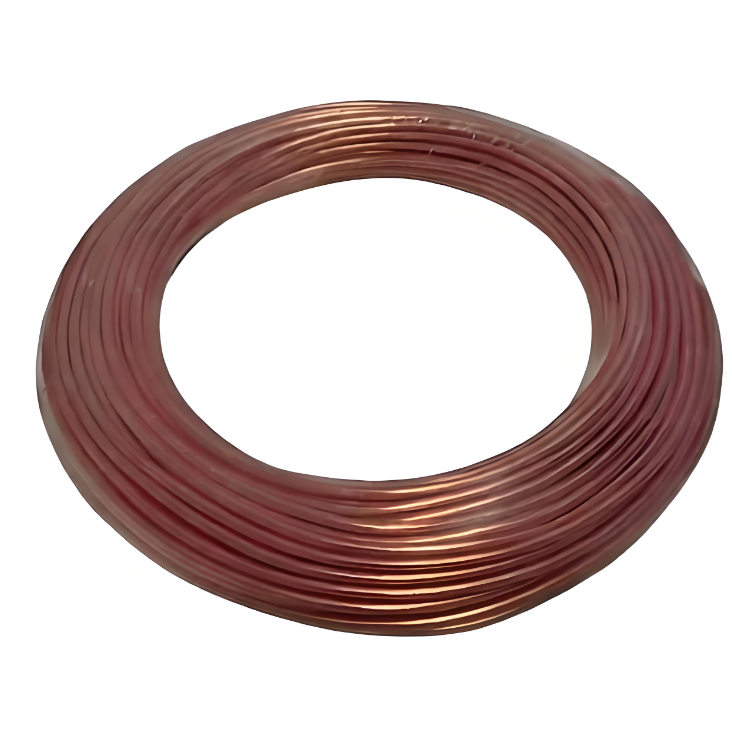
View more products about submersible pump winding wire+
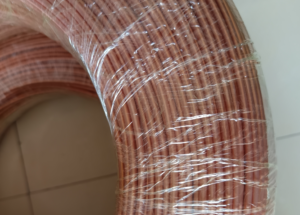
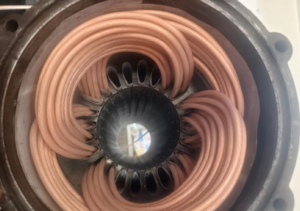
Pump and Motor Types Suited to PE2/PA Winding Wire
PE2/PA winding wire is engineered for submersible motors that operate continuously in fluid-filled environments. The following pump and motor configurations are specifically compatible.
Deep Well Submersible Pumps
The primary application for PE2/PA winding wire is deep well submersible pumps used for domestic, agricultural, municipal, and industrial water extraction . These pumps consist of a multistage centrifugal pump coupled to a water-filled submersible motor, both suspended in the well casing. The motor is filled with clean water that serves as both coolant and lubricant. Franklin Electric’s 10-inch and 12-inch rewindable motors, for example, use PE2/PA winding as standard for wells 10 inches or larger in diameter . These motors can reach immersion depths exceeding 1,100 feet and carry thrust loads up to 13,400 pounds .
6-Inch, 8-Inch, and Larger Submersible Motors
PE2/PA winding wire is used across standard submersible motor diameters. Bizzi & Tedeschi offers PE2/PA winding as an option for hot water applications across its 6-inch and 8-inch PA6/PA8 motor ranges . Vansan’s 3S motors, constructed entirely of stainless steel and wound with PE2/PA, are available in configurations suitable for wells, seawater, fountains, mining, and drinking water applications . Panelli Pumps specifies PE2/PA winding for its 8-inch motors to enable water temperatures up to 50°C .
Oil-Filled Submersible Motors
While water-filled motors dominate the application landscape, PE2/PA winding wire is also suitable for oil-filled submersible motors. The polyamide sheath provides resistance to oil immersion, protecting the polyethylene insulation from swelling or chemical degradation.
Variable Frequency Drive (VFD) Applications
PE2/PA winding wire is approved for use with variable frequency drives. Franklin Electric has conducted extensive laboratory and field testing and approves radiation-crosslinked PE2/PA winding for VFD operation, noting its “superior insulation properties and suitability” for frequency-controlled submersible motors . The high resistance of PE2/PA insulation to voltage fluctuation—arising from the VFD’s pulsed output—makes it the preferred winding for applications where motor speed control is required .
Harsh Water Conditions
PE2/PA winding wire is suitable for submersible pumps operating in water with pH values from 6.5 to 8.5, covering most natural and industrial water sources. Vansan lists seawater, fountains, mining, and industrial applications among the suitable uses for PE2/PA-wound motors . For aggressive media, motor manufacturers pair PE2/PA winding with 316 stainless steel or 904L motor shells .
Rewinding a Submersible Pump Motor with PE2/PA Winding Wire
Rewinding a submersible motor is a specialized procedure that restores the stator winding after insulation failure or thermal damage. Because PE2/PA wire is designed for rewindable motors, the process is well-established. The following steps outline the procedure.
Step 1: Motor Disassembly and Inspection
The motor is removed from the pump assembly, and the stator housing is opened. For water-filled motors, the water/glycol coolant mixture is drained and properly disposed of. The rotor is extracted, and the stator bore is inspected for damage. The old winding is examined to determine the failure mode—whether from insulation breakdown, overheating, or mechanical damage.
Step 2: Removal of Old Winding
The stator is heated in an oven to soften the impregnating varnish and facilitate wire removal. The old PE2/PA winding is carefully extracted from the slots, preserving the slot liners if they are in good condition. The stator core is then cleaned to remove all traces of old insulation, varnish, and contaminants. Damaged slot liners are replaced.
Step 3: Winding Preparation
New PE2/PA winding wire is selected based on the motor’s original specifications—conductor diameter, number of turns per coil, and winding pattern (concentric, lap, or mush). The wire is inspected for surface defects; the smooth surface finish and softness of PE2/PA wire facilitate easy winding without damage to the insulation . The required number of coils is prepared according to the motor’s winding diagram.
Step 4: Insertion of Winding Coils
The coils are inserted into the stator slots using appropriate slot wedges and insulating paper. PE2/PA wire‘s flexibility and smooth surface allow it to slide into the slots with minimal risk of abrasion . Care is taken to avoid crossing wires or damaging the polyamide sheath. The coil ends are formed and secured.
Step 5: Connections and Testing
The coil ends are connected according to the motor’s electrical configuration—star (Y), delta (Δ), or star-delta (Y-Δ) . Inter-phase insulation is installed. Before impregnation, the winding is tested for continuity, phase balance, and insulation resistance. A high-potential (hipot) test verifies dielectric integrity.
Step 6: Varnish Impregnation and Curing
The wound stator is impregnated with a suitable insulating varnish, typically by vacuum-pressure impregnation (VPI) or dip-and-bake methods. The varnish fills voids, bonds the winding, and provides additional protection. The stator is then cured in an oven according to the varnish manufacturer’s specifications.
Step 7: Final Assembly and Testing
After curing, the stator is cooled and inspected. The rotor is inserted, and the motor is reassembled with new seals, bearings (if required), and the diaphragm. The motor is filled with the specified water/glycol coolant mixture—typically a non-toxic solution providing frost protection to -15°C . Final tests include insulation resistance, DC resistance of each phase, no-load current, and rotational direction verification. The motor is then coupled to the pump and prepared for installation.
Technical Standards Governing PE2/PA Winding Wire
Chinese Industry Standards
The primary Chinese standard for PE2/PA submersible winding wire is JB/T 4014.2-2013 (“Winding wires for submersible motors — Part 2: Polyethylene insulated nylon sheathed water-resistant winding wires with rated voltages no more than 450/750V”). This standard specifies the product varieties, specifications, technical requirements, and test methods. It is issued under the jurisdiction of the National Technical Committee for Standardization of Electric Wires and Cables. Related standards include JB/T 4014.1 (General requirements) and JB/T 4014.4 (Cross-linked polyethylene insulated versions for voltages up to 600/1000V).
International Standards
IEC 60811-1-1 provides the test methods for measuring tensile strength and elongation of insulation and sheath materials. Vansan’s PE2/PA winding wire is tested to this standard, with tensile strength specified at ≥ 10 N/mm² and elongation ≥ 100% at 23°C . EBARA’s BSM 3S motor documentation references the same standard .
IEC 60093 specifies methods for determining volume resistivity and surface resistivity of solid electrical insulating materials. Vansan reports specific insulation resistance of 10¹⁴ Ω·cm at 20°C for PE2/PA wire, tested according to this standard .
DIN VDE 0303-21 (harmonized as IEC 60243-1) governs the determination of electric strength of solid insulating materials. Vansan’s published dielectric breakdown strength of 70 kV/mm at 20°C, 50 Hz for PE2/PA insulation is tested according to this standard .
DIN 53483 specifies the determination of dielectric constant. Vansan reports a dielectric constant of approximately 2.3 at 800 Hz for PE2/PA insulation, tested in accordance with this standard .
Research and Application by Leading Companies
Franklin Electric has conducted extensive laboratory and field testing of PE2/PA winding wire for submersible motors. The company’s research confirms that radiation-crosslinked PE2/PA winding exhibits “superior insulation properties and suitability” for demanding applications . Following comprehensive testing, Franklin Electric released PE2/PA winding for operation with VFDs and hot water applications up to 50°C ambient. The company continues to install PE2/PA as standard in all synchronous and 12-inch rewindable motors . Franklin Electric’s 10-inch and 12-inch rewindable motors use PE2/PA winding with IP68 protection and NSF/ANSI 61 certification for drinking water applications .
Vansan (Turkey) manufactures PE2/PA winding wire in its own factory under ISO 9001:2015 certification. Their published technical data confirms dielectric breakdown strength of 70 kV/mm, tensile strength ≥ 10 N/mm², and elongation ≥ 100% at 23°C, with these properties maintained after aging at 80°C for 7 days . Vansan positions PE2/PA winding as enabling operation at well water temperatures up to 50°C and providing “more safety factor than standard motors” .
EBARA Pumps Europe specifies PE2/PA winding wire as standard for its BSM 3S stainless steel submersible motors, citing high resistance to voltage fluctuation and long motor life .
Bizzi & Tedeschi (Italy) offers PE2/PA winding for “Hot Water” applications across its PA6 and PA8 submersible motor ranges, with insulation class rated at 90°C .
Panelli Pumps specifies PE2/PA winding for its 8-inch submersible motors to enable operation at water temperatures up to 50°C, compared to 30°C maximum with standard thermoplastic winding

Reviews
There are no reviews yet.