
View more products about submersible pump winding wire+
Insulation System: PE2 and PA Layer Dimensions
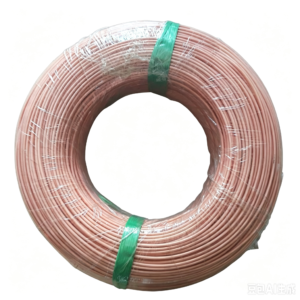
The double insulation system consists of an inner cross-linked polyethylene (PE2) layer and an outer polyamide (PA) sheath. Each layer has distinct dimensional requirements that affect the wire‘s electrical and mechanical performance.
The PE2 insulation wall thickness depends on the conductor dimensions and the operating voltage for which the wire is designed. Insulation thickness begins at 0.3 mm and increases with conductor size and voltage rating . For standard 600/1000 V applications, thinner insulation walls are acceptable, while higher voltage ratings require proportionally thicker PE2 layers.
The PA sheath is applied over the PE2 insulation as a surface protection layer. Typical PA wall thickness ranges from 0.1 mm to 0.2 mm, depending on the outer diameter of the insulated conductor . The polyamide sheath must be tightly applied with no voids or separation from the underlying PE2 layer. The PA layer provides mechanical protection during winding and operation, contributes to the wire’s smooth surface finish, and adds a secondary barrier against water ingress.
Dielectric Breakdown Voltage and Electrical Properties
The dielectric breakdown performance of the PE2/PA construction is the critical parameter determining suitability for submersible motor operation. The insulation must withstand the applied voltage plus any transient overvoltages without failing, even after prolonged immersion in water.
PE2/PA winding wire achieves a dielectric breakdown strength of 70 kV/mm when tested at 50 Hz and 20°C in accordance with DIN VDE 0303-21 . This value represents the minimum breakdown voltage per unit of insulation thickness. For a wire with 0.5 mm of PE2 insulation, this translates to a theoretical breakdown voltage of 35 kV, though actual working voltage ratings are substantially lower to provide appropriate safety margins.
The specific insulation resistance measures 10¹⁰ Ω·cm at 20°C per IEC 60093 . This high resistance ensures minimal leakage current even in water-filled motor environments where the insulation is continuously exposed to the surrounding fluid. The dielectric constant at 800 Hz is 2.3, measured according to DIN 53483 . This relatively low value indicates good insulating characteristics with minimal capacitive losses.
Voltage ratings for standard PE2/PA constructions include 1,000 V and 3,000 V . The operating temperature rating extends to 90°C, made possible by the cross-linked structure of the polyethylene insulation . This thermal rating allows reliable operation in submersible motors where heat dissipation is limited by the surrounding water environment.
Mechanical Properties and Aging Performance
The mechanical properties of PE2/PA winding wire are specified to ensure the wire can withstand the stresses of winding without cracking or breaking. At 23°C, the minimum tensile strength is 10 N/mm² and minimum elongation at break is 100%, tested in accordance with IEC 60811-1-1 .
After aging at 80°C for seven days (7×24 hours), the wire maintains its mechanical integrity, with tensile strength remaining at or above 10 N/mm² and elongation at or above 100% . This aging performance demonstrates the long-term stability of the cross-linked insulation system and its suitability for continuous operation at elevated temperatures.
Finished Product Testing
Every production batch undergoes comprehensive finished product testing to verify compliance with specification requirements. The testing protocols address the dimensional, electrical, and mechanical characteristics that determine the wire‘s fitness for submersible motor service.
Dimensional inspection verifies conductor diameter, insulation thickness, and overall wire diameter against specification tolerances. These measurements are performed on samples taken from each production lot to confirm that the manufacturing process maintains the required dimensional consistency.
Mechanical testing verifies tensile strength and elongation at break in accordance with the applicable test methods. The test procedures follow the methods specified in the IEC 60811 series for insulating and sheathing materials. The mechanical properties of the insulation are critical because the wire must survive the bending and handling stresses of motor winding operations.
Electrical testing includes insulation resistance measurement and breakdown voltage verification on finished wire samples. Test procedures follow the methods specified in the IEC 60851 series for winding wire test methods. The breakdown voltage test applies increasing voltage across the insulation until failure occurs, with results compared against the minimum specified values.
Water resistance testing is particularly important for submersible applications. Finished wire samples are immersed in water at elevated temperature for extended periods, after which insulation resistance and breakdown voltage are re-measured to confirm that water exposure has not degraded the insulation system.
International Technical Standards
The manufacture and testing of PE2/PA submersible winding wires is governed by a combination of national and international standards, with the specific applicable standard depending on the destination market and customer requirements.
The primary Chinese standard for this product category is the JB/T 4014 series, issued by the Ministry of Industry and Information Technology. Part 4 of this standard, JB/T 4014.4-1996, specifically addresses cross-linked polyethylene insulated nylon sheathed water-resistant winding wires with rated voltages up to 600/1000 V . The general requirements specified in JB/T 4014.1-1996 cover test methods, inspection rules, and packaging requirements for all parts of the series .
For the Indian market, the applicable standard is IS 8783, “Winding wires for submersible motors – Specification” . Part 4 Section 3 of this standard covers cross-linked polyethylene insulated and polyamide jacketed constructions, providing an alternative certification pathway for customers in the Indian market.
At the international level, IEC 60317-0-1:2013 specifies general requirements for particular types of winding wires, including enamelled round copper wire . The fourth edition of this standard includes revisions to Clause 13 (Breakdown voltage) to address new requirements for intermediate wire diameters and revisions to continuity of insulation requirements . The test methods for winding wires are specified in the IEC 60851 series, which provides the procedures for determining electrical, mechanical, and thermal properties .
For dielectric breakdown strength testing, DIN VDE 0303-21 provides the German standard for testing electric strength of solid insulating materials at power frequencies. For mechanical property testing of insulation and sheathing compounds, IEC 60811-501 specifies the procedure for determining tensile strength and elongation . Measurement of sheath thickness is governed by IEC 60811-202, which provides methods applicable to cross-linked and thermoplastic compounds

Reviews
There are no reviews yet.