
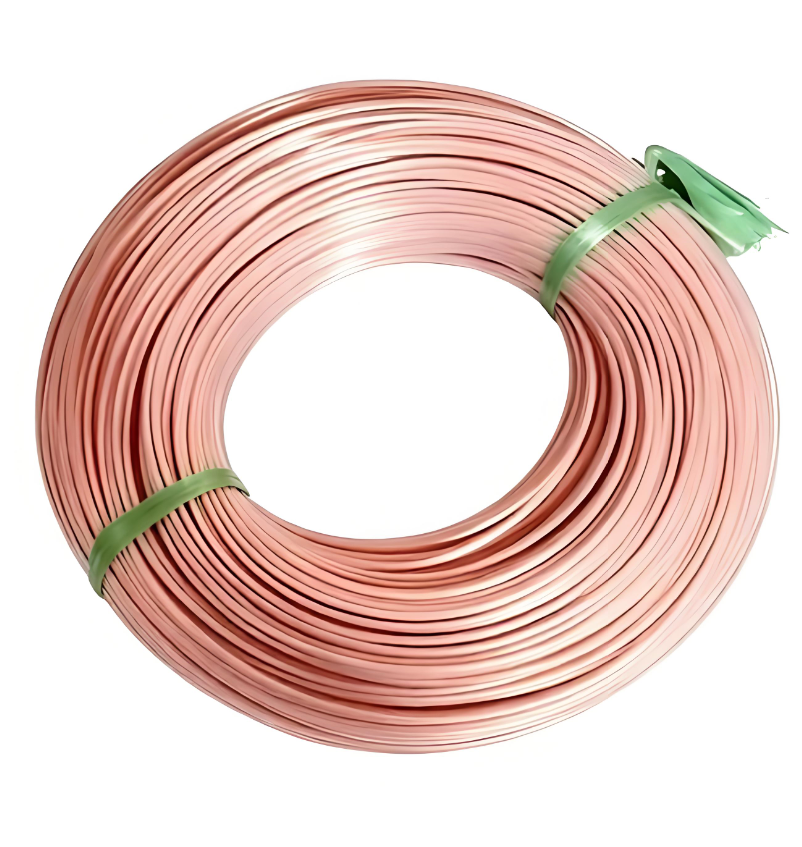
View more products about submersible pump winding wire+
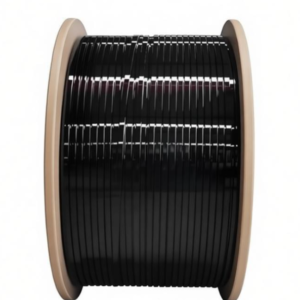
Composition and Layer Architecture
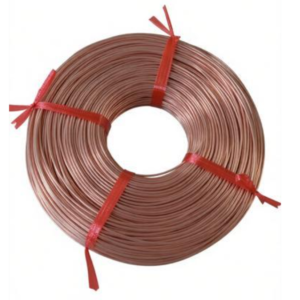
The wire begins with a single copper conductor, either solid or stranded, with conductor diameters spanning approximately 0.6 mm to 4.6 mm for solid constructions and extending to 17.1 mm for multistranded versions . The copper is bare, electrolytic grade, cleaned before extrusion to ensure adhesion with the polymer layers.
The PE2 layer is applied directly over the copper. Cross-linked polyethylene is formed by bombarding extruded polyethylene with high-energy electrons or by chemical cross-linking agents, creating covalent bonds between polymer chains . The result is a thermoset dielectric that does not soften at elevated temperatures. The insulation wall thickness ranges from 0.3 mm to 3.5 mm depending on the voltage rating . The PE2 layer provides the electrical isolation: dielectric breakdown strength of 70 kV/mm, specific insulation resistance of 10^16 Ω·cm, and a dielectric constant of 2.3 at 800 Hz .
The PA sheath is extruded over the PE2. Its thickness is comparatively thin, typically 0.1 mm to 0.3 mm, and it performs no primary electrical function . The polyamide serves as a mechanical barrier: it resists abrasion during winding insertion, provides a low-friction surface for wire feeding, and protects the PE2 dielectric from cut-through when the wire contacts slot edges or crosses over itself in end-turn regions . The layer sequence—copper, then PE2, then PA—means the electrical insulation is fully formed before the protective skin is applied.
Taiwan Market Presence
Precise market share statistics for PE2/PA winding wire in Taiwan are not publicly segmented. What is evident from available sources is that the wire is produced domestically and deployed across the island’s submersible motor manufacturing sector. Pacific Electric Wire & Cable (PEWC), Taiwan’s first manufacturer of submersible motor winding wire, has produced these products for over three decades and explicitly lists “PE+NYLON” and “XLPE” insulation among its offerings for submersible motor coils . Another Taiwanese supplier, Chung Kuang Electric Wire & Cable in Taichung, produces PE-NY compound insulated wire for submersible pump coils, rated at 75°C and 450/750 V, with RoHS compliance and CE certification .
The market for submersible pumps in Taiwan is served by a mix of domestic manufacturers and international brands. The domestic producers include Showfou Electric Machine, which describes itself as the largest submersible pump manufacturer in Taiwan, operating from Kaohsiung with ISO 9001, CSA, UL, and CE certifications . Walrus Pump (大井泵浦), founded in 1967, is a publicly listed pump manufacturer with factories in New Taipei, Kaohsiung, and Suzhou, serving construction, industrial, and technology sectors . Both companies manufacture submersible motors that require insulation systems suitable for continuous immersion.
PE2/PA wire occupies the higher-performance tier of submersible winding wires in Taiwan, positioned above PVC-insulated wire for applications where water temperatures exceed 30°C or where operating voltage demands greater dielectric margin. The wire’s compatibility with variable frequency drive operation, as noted in international motor specifications, makes it suitable for modern energy-efficient pump systems .
Walrus Pump: Application Analysis
Walrus Pump Industrial Co., Ltd. (大井泵浦工業股份有限公司) represents a compelling case study for examining how a prominent Taiwanese motor brand approaches submersible winding insulation. Founded in 1967 and listed on the Taipei Exchange under ticker 6982, Walrus is one of Taiwan’s most established pump manufacturers, with over five decades of continuous operation and annual revenue exceeding NT$1.6 billion .
Walrus maintains its own motor production capability, having begun self-manufacturing motors in 1991 . This vertical integration means the company controls the winding process and selects the insulation materials used in its submersible motors. The company operates a dedicated pump and motor testing laboratory certified by TAF, ILAC, and TUV, and has obtained IE3 Motor inside authorization from Taiwan’s Industrial Technology Research Institute . These credentials indicate that Walrus applies engineering rigor to motor design and validation.
The company’s product portfolio includes submersible pumps for drainage, sewage, and water supply applications . Submersible motors in these categories operate under continuous immersion, often with water temperatures that can rise during sustained operation. The insulation system must therefore provide reliable dielectric performance and resist the thermal and mechanical stresses of wet-stator service.
While Walrus does not publicly specify the exact insulation construction of every motor model, the performance requirements of its submersible product lines align with PE2/PA or equivalent high-grade insulation. The company emphasizes energy efficiency, having adopted IE3 and IE4 motor designs, and holds certifications including CE, RoHS, CSA, and UL . Motors built to these standards for submersible applications require insulation that can withstand VFD waveforms, thermal cycling, and water exposure. PE2/PA insulation satisfies these requirements through its cross-linked polyethylene dielectric, which provides thermal stability up to 90°C, and its polyamide sheath, which preserves the dielectric integrity during winding and operation .
The economic logic for Walrus and similar Taiwanese manufacturers is straightforward. PE2/PA wire is domestically available from established suppliers like PEWC, which has produced submersible motor wire for over thirty years . The wire’s performance characteristics support the reliability claims that underpin brand reputation in the pump industry. For submersible motors that may operate for years without inspection, the insulation system is not a component where compromise is economically rational.

Reviews
There are no reviews yet.