
View more products about submersible pump winding wire+
Product Identification and Construction
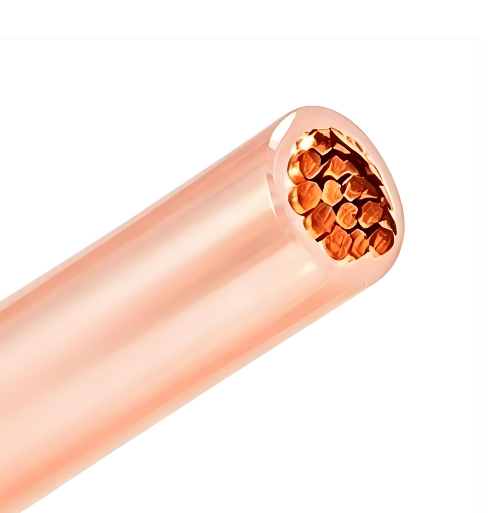
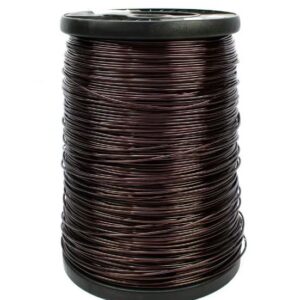
The designation 19×0.68 PE2-PA refers to a stranded copper conductor composed of 19 individual copper wires, each with a nominal diameter of 0.68 mm. This construction yields a nominal cross-sectional area of approximately 6.9 mm². The conductor is insulated with a dual-layer system: an inner sheath of cross-linked polyethylene (PE2) and an outer polyamide (PA) sheath, commonly known as nylon .
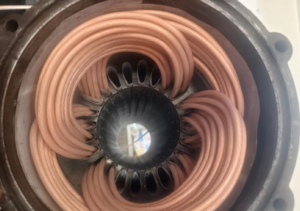
The stranded configuration is essential for this conductor size. A solid copper conductor of 6.9 mm² would be too stiff to wind efficiently into the stator slots of a submersible motor. By dividing the conductor into 19 individual strands, the wire achieves the flexibility required for tight winding radii while maintaining the current-carrying capacity needed for motors in the 15 kW to 30 kW range. The 19-strand construction also provides redundancy; minor damage to individual strands during handling does not compromise the conductor‘s overall electrical integrity.
The PE2 insulation layer provides the primary dielectric barrier. Cross-linking transforms the polyethylene from a thermoplastic to a thermoset material, significantly improving its thermal stability and resistance to deformation under electrical stress . The PA sheath, typically applied in thicknesses ranging from 0.1 mm to 0.2 mm depending on the outer diameter of the insulated conductor, serves a dual purpose: it protects the PE2 insulation from mechanical abrasion during winding and operation, and it provides a smooth surface finish that facilitates efficient winding .
Electrical and Mechanical Characteristics
The electrical performance of the 19×0.68 PE2-PA wire is governed by the properties of the cross-linked polyethylene insulation. The dielectric breakdown strength reaches 70 kV/mm when tested at 50 Hz and 20°C in accordance with DIN VDE 0303-21 . The specific insulation resistance measures 10¹⁰ Ω·cm at 20°C per IEC 60093, ensuring minimal leakage current even in water-filled motor environments .
The mechanical properties are equally critical for submersible applications. At 23°C, the insulation achieves a minimum tensile strength of 10 N/mm² and minimum elongation at break of 100%, tested in accordance with IEC 60811-1-1 . After aging at 80°C for seven days (7×24 hours), these values remain at or above the same minimums, demonstrating the long-term stability of the cross-linked insulation system . This aging performance is particularly relevant for submersible motors that operate continuously at elevated water temperatures.
The operating temperature rating for PE2-PA winding wire extends to 90°C, made possible by the cross-linked structure of the polyethylene insulation . This thermal rating allows reliable operation in submersible motors where heat dissipation is limited by the surrounding water environment.
Manufacturing Process
The production of 19×0.68 PE2-PA winding wire involves several precision manufacturing stages. The process begins with high-purity copper rod that is drawn through successive dies to reduce the wire diameter to 0.68 mm. Nineteen individual strands are then bunched or stranded together using a stranding machine that controls the lay length and direction to achieve the desired flexibility and mechanical integrity.
Following stranding, the conductor is annealed to restore softness and flexibility lost during the drawing process. The annealed conductor is then cleaned to remove any residual oils or oxides before insulation application.
The PE2 insulation is applied through an extrusion process. The cross-linking of the polyethylene is achieved through either irradiation or a chemical process, depending on the manufacturer‘s capabilities and the specific compound used. Irradiation cross-linking uses high-energy electron beams to create molecular bonds between polymer chains without the need for chemical cross-linking agents. This method produces insulation with excellent electrical properties and consistent cross-linking density .
The PA sheath is applied over the PE2 insulation through a separate extrusion process. The polyamide material, typically nylon 1010 or a comparable grade, is extruded at controlled temperature and thickness to achieve the specified wall dimensions. The PA layer must be tightly bonded to the underlying PE2 insulation without voids or separation .
Throughout production, in-line measurement devices monitor conductor diameter, insulation thickness, and overall wire diameter. Finished product testing includes high-voltage withstand testing in water, dimensional inspection, and mechanical property verification .
Application Scope and Market Deployment
The 19×0.68 PE2-PA winding wire is designed for water-filled submersible motors, commonly known as “wet motors,” where the stator winding is directly exposed to the surrounding fluid. The combination of the PE2 insulation‘s water resistance and the PA sheath’s mechanical protection makes this construction suitable for continuous submersion .
Primary applications include deep well pumps for agricultural irrigation and municipal water supply, where motors operate for years with minimal maintenance access. Mining dewatering systems benefit from the wire‘s resistance to water chemistry variations, with PE2-PA constructions designed for water pH values between 6.5 and 8.5 . Power plant cooling systems represent a sensitive application where long-term reliability is paramount; the PE2/PA construction is specified for circulation pumps in these critical installations . Oil and gas platforms use submersible motors for firefighting systems and artificial lift, where the wire must withstand both water and hydrocarbon exposure .
For the Indian market, the applicable standard is IS 8783 Part 4 Section 3, which specifies requirements for cross-linked polyethylene insulated and polyamide jacketed winding wires for submersible motors . For the Chinese market, JB/T 4014.4-2013 governs the manufacture and testing of cross-linking polyethylene insulated and nylon sheathed winding wires with rated voltages up to 600/1000 V . For the European market, DIN VDE 0303-21 provides the test method for dielectric breakdown strength, with results expressed in kV/mm

Reviews
There are no reviews yet.