
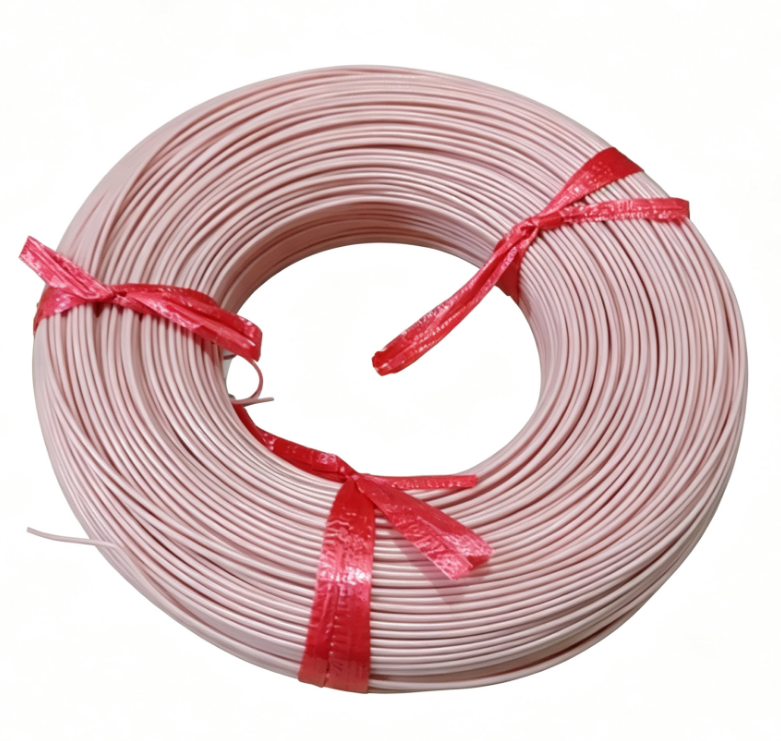
View more products about submersible pump winding wire+
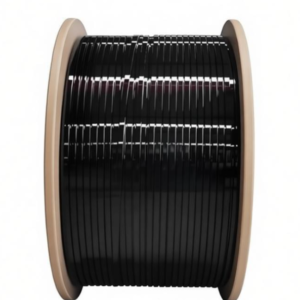
Composition of the PE2/PA Submersible Winding Wire
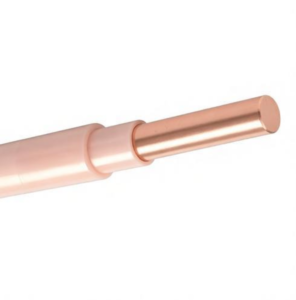
The wire begins with a copper conductor. For submersible motor applications, this conductor is either a single solid copper strand or a bundle of stranded wires, depending on the required flexibility and cross-sectional area. Solid conductors span diameters from roughly 0.6 mm to 4.6 mm, while stranded versions extend from 3.6 mm to 17.1 mm in diameter, accommodating cross-sectional areas up to 150 mm² . The copper used is typically electrolytic-tough-pitch grade with conductivity exceeding 99.9 percent, ensuring minimal resistive losses during continuous operation. The conductor surface must be exceptionally clean before insulation application; any residual drawing lubricant or oxide film will compromise adhesion between the metal and the polymer, creating a potential pathway for moisture migration along the conductor.
The primary dielectric layer is cross-linked polyethylene, designated PE2 in the industry nomenclature. The polyethylene compound is deliberately free from lead and chlorine, addressing both environmental regulations and long-term chemical stability in submerged service . The “2” in PE2 indicates physical cross-linking rather than chemical. In the physical process, the extruded polyethylene is bombarded with high-energy electrons, which break carbon-hydrogen bonds and create free radicals that recombine to form covalent cross-links between polymer chains. This radiation-induced cross-linking transforms the polyethylene from a thermoplastic that softens with heat into a thermoset material that maintains its shape and dielectric properties at elevated temperatures. The practical consequence is a temperature rating of 90°C for the insulation itself, with continuous operation in water up to 50°C achievable without derating in properly designed motors . The insulation wall thickness varies according to the voltage rating, ranging from 0.3 mm for low-voltage wires to 3.5 mm for high-voltage constructions .
The outermost layer is polyamide, commonly known as nylon. This sheath is thin, typically between 0.1 mm and 0.3 mm, and serves no primary electrical function . Its role is mechanical. During the winding process, the wire is pushed through slot liners, bent around stator teeth, and crossed over itself in the end-turn region. The polyamide provides a tough, low-friction surface that resists abrasion and cut-through, protecting the critical cross-linked polyethylene layer from damage that could compromise dielectric integrity. The polyamide also contributes to the wire’s overall chemical resistance, though the polyethylene layer remains the primary barrier against water ingress.
For applications requiring operating voltages of 3 kV and above, an additional semiconducting layer may be applied between the copper conductor and the PE2 insulation . This layer, with thickness between 0.15 mm and 0.3 mm, equalizes the electric field at the conductor surface and prevents localized stress concentrations that could initiate dielectric breakdown under high-voltage stress.
Global Market Position
The submersible winding wire market operates within a broader ecosystem of submersible pump manufacturing, repair, and maintenance. Precise market share figures for PE2/PA wire specifically are difficult to isolate, as market research reports typically aggregate all submersible winding wire types—PVC, PE, VPE, PE2/PA, and high-temperature variants—under a single category . What is clear from the available data is that the Asia-Pacific region represents the largest and fastest-growing market for submersible winding wire, driven by agricultural irrigation, municipal water supply, and industrial applications across China, India, and Southeast Asia . China has emerged as a major production base, with manufacturers in Hebei and other provinces supplying PE2/PA wire to both domestic motor builders and export markets .
Within the product-type segmentation, PE2/PA occupies the premium tier of standard submersible winding wires, positioned above PVC and basic PE but below specialized high-temperature insulation such as HT4. The wire is not a commodity in the sense that PVC-insulated wire is; its production requires radiation cross-linking capability or chemical cross-linking know-how, and quality control must verify dielectric breakdown strength of at least 70 kV/mm and insulation resistance on the order of 10^16 Ω·cm . These requirements create barriers to entry that limit the number of qualified manufacturers. The major global players include NSW in Germany, which has produced winding wires since 1946 and supplies PE2/PA under its own brand ; Vansan in Turkey, which claims to be the only submersible motor manufacturer that produces its own PE2/PA winding wire ; and a growing roster of Indian and Chinese manufacturers serving regional markets .
The competitive landscape is fragmented, with no single supplier dominating globally. This fragmentation benefits motor rewinders and pump manufacturers, who can source PE2/PA wire from multiple qualified producers and negotiate on price without sacrificing technical performance. The wire’s adoption is driven less by brand preference than by application requirements: any submersible motor expected to operate in water warmer than 30°C, or at voltages above standard low-voltage ratings, needs PE2/PA or an equivalent high-grade insulation.
Korean Water Pump Brands Using PE2/PA Winding Technology
South Korea hosts a mature pump manufacturing sector, with over 8,000 companies active in the pumps, compressors, taps, and valves industry . Several Korean manufacturers produce submersible pumps and motors that incorporate PE2/PA winding wire or equivalent high-grade insulation systems.
Samjin Industrial (삼진공업) manufactures submersible motor pumps, propeller pumps, submersible agitators, and caned motor pumps from its facility in Cheonan, Chungcheongnam-do . The company has been operating since 1978 and supplies pumps for construction, industrial, and water treatment applications. Submersible motor pumps, by their nature, require insulation systems capable of continuous immersion, and PE2/PA wire is the industry-standard choice for motors in this class.
Jicheon Pump Industrial (지천펌프공업)produces submersible pumps, submersible aerators, and submersible mixers from its base in Gimpo, Gyeonggi-do . The company has supplied pumps to domestic environmental and construction sites and exports to Southeast Asian markets including Thailand and China. Its product line includes submersible pumps designed for continuous duty in water and wastewater applications.
NS Hydro (엔에스하이드로) is a more recent entrant, founded in 2016, that manufactures submersible pumps, submersible axial and mixed-flow pumps, and sludge recirculation pumps . The company holds KS certification, ISO certification, and high-efficiency energy equipment certification, and has been designated for excellent procurement products. Its submersible pumps serve rainwater pumping stations, agricultural drainage, and industrial applications.
GreenTech (그린텍) manufactures pumps for building services, agriculture, and industry, with a focus on supplying government agencies, large water treatment companies, and overseas plant projects . The company has developed IoT-enabled pumps with real-time monitoring capabilities and has obtained CE certification for its products. Its submersible pump line includes axial and mixed-flow designs with capacities up to 1,000 m³/min.
Poonglim Precision Industry (풍림정공) specializes in stainless steel submersible pumps for aquaculture and construction applications . Founded in 2003, the company has obtained ISO 9001 and KS certification for its construction submersible pumps, and its products are used by POSCO and various industrial complexes. The company has also begun exporting to Japan and is expanding into marine and fisheries applications.
These brands represent the range of Korean pump manufacturers that depend on high-grade winding insulation for their submersible motor products. While not all explicitly specify PE2/PA in their public materials, the performance requirements of submersible motor applications—continuous immersion, elevated water temperatures, and voltage stress—make PE2/PA or equivalent insulation the practical standard for any motor expected to deliver reliable service.

Reviews
There are no reviews yet.