
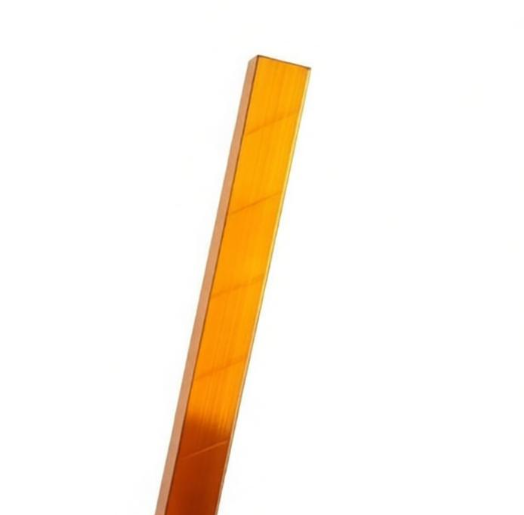
View more products about kapton film covered winding wires+
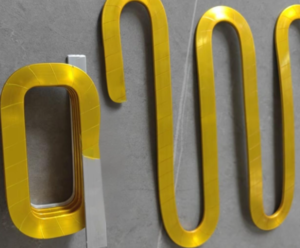
Conductor Specifications
The aluminium conductor used in polyimide film covered wire is manufactured from high-purity electrical grade aluminium. According to GB5584.3-85, the conductivity resistance at 20°C must not exceed 0.02801 Ω·mm²/m . For rectangular conductors, the dimensions and corner radii must conform to GB/T7673.1-87 standards .
Rectangular aluminium conductors are available in thicknesses ranging from 0.90mm to 8.00mm and widths from 2.00mm to 25.00mm . Extended ranges cover cross-sectional areas from 5 mm² to 120 mm² . Round conductors are available with diameters from 2.0mm to 7.0mm . The conductor surface must be smooth, clean, and free from abrasions, burrs, oil, or metal foam .
Polyimide Film Insulation
The insulation system utilises a multi-layer polyimide film with a fluoropolymer (FEP) coating that functions as a heat-fusible layer . This composite film, available as single-side FEP coated (type FH) or double-side FEP coated (type FHF), provides several critical advantages.
The FEP coating enables thermal bonding during the manufacturing process. When the wrapped wire is heated, the FEP layer melts and flows, filling gaps between overlapping film layers and creating a seamless, void-free insulation structure . This sintering process is essential for achieving the insulation system’s outstanding dielectric integrity.
Insulation Configurations
Polyimide film covered aluminium wire is available in multiple insulation configurations to suit different voltage requirements:
Single-layer wrapping provides basic dielectric protection for lower voltage applications. The film is applied with controlled overlap, typically up to 66% .
Double-layer construction consists of two layers applied in opposite directions, ensuring complete coverage and enhanced mechanical strength. This cross-lapped configuration is standard for high-voltage applications .
Multi-layer configurations with three or more layers are available for the most demanding voltage requirements .
Dimensional and Performance Specifications
Insulation Thickness and Breakdown Voltage
Breakdown voltage varies with insulation thickness and wrapping configuration. For single-layer wrapping on conductors with narrow side a≤3.00mm, breakdown voltage ranges from 2,000V to 4,000V depending on the specific insulation thickness . Double-layer wrapping on the same conductor size achieves 3,000V to 7,000V .
For larger conductors with a ranging from 3.00mm to 6.00mm, single-layer breakdown voltage ranges from 1,500V to 3,000V, while double-layer configurations achieve 2,500V to 5,000V . Industry sources indicate breakdown voltages exceeding 8 kV for Kapton insulated wires .
Standard insulation thickness options available include 0.15mm, 0.23mm, 0.30mm, 0.45mm, 0.80mm, and thicker configurations up to 4.25mm . Tolerances range from ±0.03mm for thinner constructions to ±0.30mm for thicker builds .
Thermal Performance
Polyimide film insulated aluminium wire is rated for continuous operation at 220°C (Class H) . The insulation maintains its electrical and mechanical properties across a wide temperature range from -196°C to +250°C, with no melting point and self-extinguishing characteristics .
Manufacturing Process
Conductor Preparation
The manufacturing process begins with aluminium rods that are continuously extruded to form the required conductor profile. For rectangular conductors, the extrusion process is followed by precision sizing to achieve the specified dimensions and corner radii . The conductor is then cleaned to remove surface contaminants that could affect insulation adhesion.
Film Wrapping
The polyimide film is applied using precision wrapping machinery with controlled tension. For single-layer constructions, the film is wrapped with overlap up to 66% . For double-layer constructions, the second layer is applied in the opposite direction (cross-lapped) to ensure complete coverage .
Heat Sealing and Sintering
Following wrapping, the wire is passed through a high-temperature sintering oven. The FEP fluoropolymer coating on the polyimide film melts and flows, filling gaps between overlapping film layers and between the film and the conductor surface . Upon cooling, the FEP solidifies, creating a homogeneous, void-free insulation structure.
Key Applications
Traction Motors
Polyimide film covered aluminium wire is extensively used in railway traction motors. These motors must withstand high temperatures, frequent load changes, and continuous vibration . The insulation system provides exceptional overload protection and long motor life in these demanding applications . The aluminium conductor contributes to weight reduction, improving overall vehicle efficiency.
Aerospace Equipment
The combination of lightweight aluminium and high-temperature polyimide insulation makes this wire ideal for aerospace applications. Kapton insulated wire has been adopted in over 70 military and commercial aircraft applications, valued for its low weight, low smoke toxicity, and ability to withstand temperature extremes .
High-Voltage Motors and Generators
Motors for heavy-duty industrial applications and power generators benefit from the high dielectric strength and thermal stability of polyimide film insulated aluminium wire . The insulation system withstands the electrical and thermal stresses of continuous high-voltage operation.
Submersible Motors
The waterproof and oil-proof nature of polyimide film insulation makes this wire suitable for submersible motor applications, where the insulation must maintain integrity in contact with water and oils .
Standards Compliance
Polyimide film covered aluminium wire is manufactured in compliance with multiple international standards. For rectangular aluminium wire, IEC 60317-73 specifies requirements for class 200 enamelled rectangular aluminium wire with dual coating, covering conductor width from 2.0mm to 16.0mm and thickness from 0.80mm to 5.60mm . For round aluminium wire, IEC 60317-25 covers class 200 enamelled round aluminium wire .
Chinese standards including GB5584.3-85 for aluminium conductor materials and GB/T7673.1-87 for flat conductor dimensions are also applicable

Reviews
There are no reviews yet.