
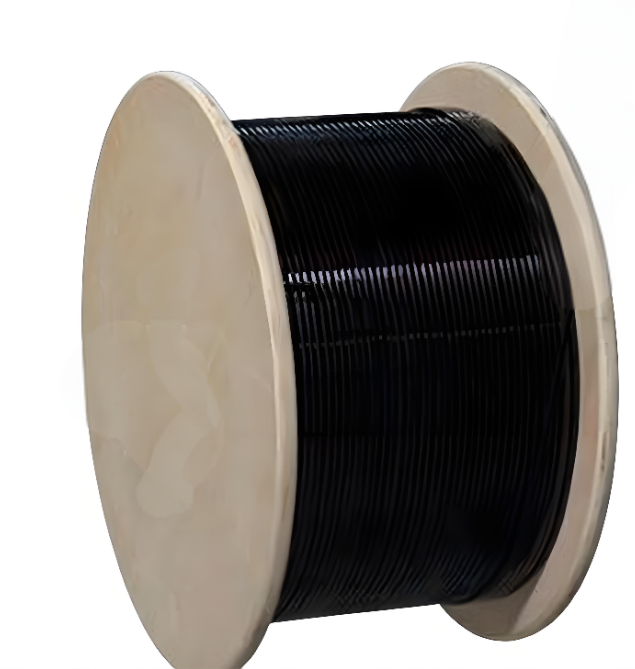
View more products about flat enameled aluminium wire+
1. Electrical Resistance and Conductivity
The DC resistance of the aluminum conductor directly determines winding losses (I²R loss) and transformer efficiency.
Resistivity Specifications:
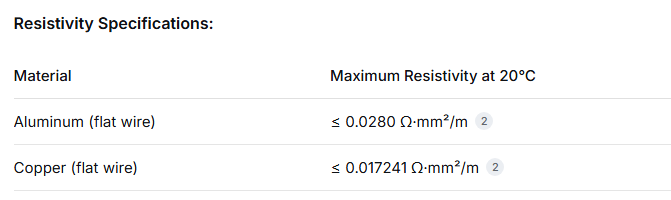
Aluminum’s resistivity is approximately 1.6 times higher than copper’s. However, the rectangular cross-section compensates through geometry: a higher fill factor reduces the required winding length, lowering total resistance for a given slot area.
Purity–Resistance Relationship: Aluminum purity must be ≥ 99.7% to maintain resistivity ≤ 0.0278 µΩ·m. Dropping to 99.5% purity raises resistivity by 2.3%, directly increasing I²R losses by the same factor—enough to push a 2-MVA transformer from Tier-2 to Tier-3 loss evaluation, eroding the OEM’s profit margin.
Load-Loss Impact: Transformer load losses (Pₖ) are governed by winding resistance. For a 1 MVA transformer, every incremental increase in resistance translates to higher operating costs over the transformer’s 30+ year lifespan. This is why dimensional precision (width/thickness tolerances) is enforced: even a slight deviation increases cross-sectional area variation, altering the specified resistance value.
2. Application in Transformer Windings
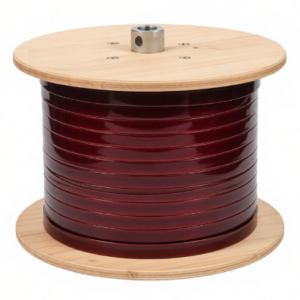
Rectangular enameled aluminum wire is engineered specifically for large power transformers and distribution transformers where efficiency, thermal management, and cost optimization are paramount.
Space Factor Advantage: The rectangular cross-section allows close-packing in the winding window, achieving a slot fill rate significantly higher than round wire. This translates to more ampere-turns in the same core volume, increasing power density without enlarging the transformer footprint.
Loss Reduction Mechanism:
-
End-Turn Shortening: Rectangular conductors reduce the length of winding overhangs (end turns) compared to round wire, lowering total resistance and thus I²R losses.
-
Weight and Cost: Aluminum windings are 28–34% lighter and 17–22% cheaper than copper equivalents while meeting identical load-loss guarantees when purity and dimensions are tightly controlled.
Thermal Performance: Flat conductors have a larger surface area per unit volume than round conductors of equivalent cross-section, improving heat dissipation. Effective cooling is critical in large transformers where winding hotspots can exceed 190°C, potentially causing enamel cracking and inter-turn shorts. Field failures from poor enamel quality—such as eccentricity below 62% or excessive pinholes—have resulted in rewind costs exceeding USD 28,000 for a 1 MVA unit.
Winding Considerations: Grade 1 vs. Grade 2 insulation thickness impacts both breakdown voltage and thermal conductivity. Grade 2 (thicker coating) provides higher dielectric strength and abrasion resistance, making it preferred for high-voltage transformer windings. The wire must also pass flexibility tests—bending over mandrels of 3–4 times the width/thickness without cracking—to survive coil winding and insertion processes

Reviews
There are no reviews yet.