
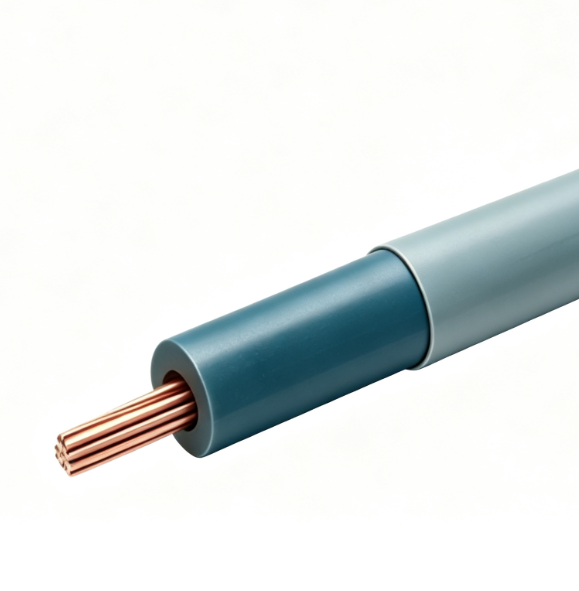
View more products about submersible pump winding wire+
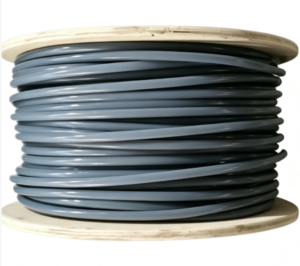
Conductor Specifications: Solid and Stranded Configurations
The copper conductor for medium voltage submersible winding wire is manufactured from oxygen-free copper in accordance with GB/T 6108 for winding wire conductors and GB/T 3953 for electrical round copper wire . The conductor may be solid or stranded, with the choice determined by the required cross-sectional area and the flexibility needed for winding into motor stator slots.
For medium voltage applications, stranded conductors are typically specified. Industry production data indicates conductor diameter ranges from Φ0.20 mm to Φ5.00 mm, with stranded constructions including 7-strand, 19-strand, 37-strand, 49-strand, and 61-strand configurations . Multi-strand conductors must conform to the stranded round copper requirements of GB/T 3953, which specifies the technical requirements for electrical round copper wire used in winding applications .
The conductor structure for medium voltage winding wire is not limited to a single configuration. The specific stranding pattern is selected based on the motor design requirements, including current-carrying capacity, slot fill factor, and winding flexibility. Larger cross-sectional areas generally employ higher strand counts to maintain flexibility while meeting the electrical conductivity requirements.
Dielectric Breakdown Voltage and Electrical Properties
The dielectric breakdown performance of the HL+XLPE+PA construction is the critical parameter determining suitability for 6.6kV–10kV operation. The rated voltage for this construction is specified as Uo/U = 6600/10000V, making it suitable for water-filled submersible motors and similar electrical equipment operating under cross-linked high-voltage conditions .
Withstand voltage testing requirements provide a practical measure of dielectric strength. According to industry technical requirements for underwater motor windings, the stator winding must withstand a power-frequency withstand voltage test at 80%×(2Ue+1000V)/min without breakdown . For a 6kV rated motor, the test voltage is specified as 13000V, and for a 10kV rated motor, 21000V . These values correspond to the standard test voltages applied to complete winding assemblies to verify insulation integrity before and after installation.
The inter-turn impulse withstand voltage requirement for underwater motor windings is specified as not less than 1.7 UG, where UG is the power-frequency withstand voltage test value for the stator or rotor winding to ground . For 6kV rated motors, the inter-turn impulse test value is 22100V; for 10kV rated motors, 35700V . These impulse tests verify the insulation system‘s ability to withstand the voltage transients that occur during motor switching and operation.
The mechanical and physical properties of the XLPE insulation layer are specified in industry technical documentation. The minimum tensile strength before aging is 15.0 N/mm², with a maximum variation of ±25% after aging at 90°C for 28 days. Elongation at break is a minimum of 200% . These properties ensure the insulation maintains its physical integrity under the combined thermal and mechanical stresses of motor operation.
Finished Product Testing
Every production batch undergoes comprehensive finished product testing to verify compliance with specification requirements. The testing protocols address the dimensional, electrical, and mechanical characteristics that determine the wire’s fitness for medium voltage submersible motor service.
Dimensional inspection verifies conductor diameter, insulation thickness, eccentricity, and overall wire diameter against specification tolerances. The insulation thickness average must be at least 90% of nominal value, with eccentricity not exceeding 10% in any cross-section . These dimensional controls are critical because the dielectric strength of the insulation system depends on maintaining the specified wall thickness uniformly around the conductor circumference.
Electrical testing includes high-voltage withstand testing on finished wire samples. For 6kV class wire, the test voltage is typically 12000V applied for 5 minutes, while 10kV class wires require proportionally higher test voltages . The test procedures follow the methods specified in applicable standards for winding wire electrical testing.
Water resistance testing is particularly critical for submersible applications. The wire must maintain its insulation resistance and dielectric strength after prolonged immersion in water at elevated temperature and pressure. The operating conditions for which this construction is designed include water pH range of 6.5–8.5 and hydraulic pressure capability of 3 MPa . The working temperature rating is 90°C, consistent with the thermal classification of the XLPE insulation material.
International Technical Standards
The manufacture and testing of 6.6kV–10kV submersible motor winding wire with HL+XLPE+PA construction is governed by a combination of national and international standards, with the specific applicable standard depending on the destination market and customer requirements.
The primary Chinese standard for submersible motor winding wires is the JB/T 4014 series, issued by the Ministry of Industry and Information Technology. Part 4 of this standard, JB/T 4014.4-2013, addresses cross-linked polyethylene insulated nylon sheathed water-resistant winding wires . The general requirements and test methods specified in the broader JB/T 4014 series apply to the full range of submersible winding wire constructions, including medium voltage types.
For electrical properties testing of wires and cables, GB/T 3048 specifies the applicable test methods . This standard provides the procedures for verifying electrical characteristics including conductor resistance, insulation resistance, and withstand voltage.
At the international level, the Indian standard IS 8783 series addresses winding wires for submersible motors. Part 4, Section 2 of this standard specifically covers cross-linked polyethylene insulated and polyamide jacketed wires, providing an alternative certification pathway for customers in the Indian market .
The International Electrotechnical Commission maintains the IEC 60317 series for winding wire specifications, including general requirements for particular types of winding wires. While this series does not currently include a dedicated section for HL+XLPE+PA medium voltage submersible winding wire, its testing methodologies are widely referenced. The German standard DIN VDE 0303-21 provides the test method for dielectric breakdown strength at power frequencies, with results expressed in kV/mm .
Application Scope
The 6.6kV–10kV HL+XLPE+PA submersible winding wire is designed for AC rated voltage Uo/U of 6600/10000V water-filled submersible motors and similar electrical equipment operating under comparable conditions . Primary applications include mining drainage systems requiring high-voltage submersible pumps for deep mine dewatering, seawater pumping installations where reliable dielectric performance and corrosion resistance are essential, and industrial applications where medium voltage submersible motors offer advantages over low-voltage alternatives for large power ratings.
The construction is also applicable to cross-linked high-voltage submersible motor winding applications, sometimes designated as SXLPE waterproof winding wire . The combination of electric field control through the HL semiconducting layer, high dielectric strength from XLPE insulation, and mechanical protection from the PA sheath addresses the specific demands of medium voltage operation in submerged environments where conventional insulation systems would be vulnerable to water treeing and dielectric failure.

Reviews
There are no reviews yet.