
View more products about submersible pump winding wire+
Cable Construction
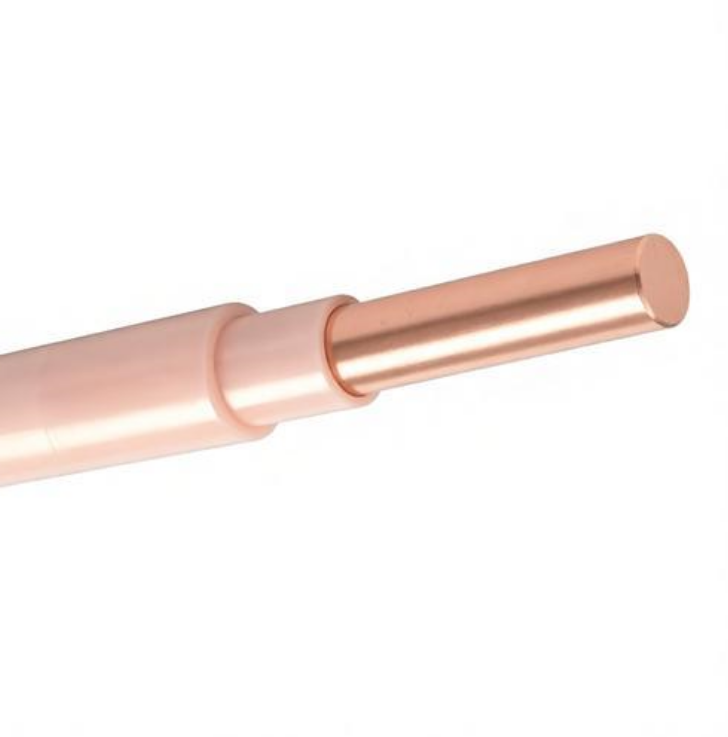
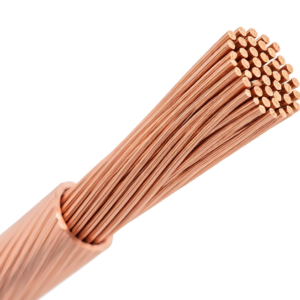
The conductor is manufactured from high-conductivity annealed copper, compliant with the conductor data requirements of IS 8783 (Part 1) . The 3.35/4.6mm designation suggests a stranded configuration—common constructions include 7-strand or 19-strand arrangements where individual wire diameters fall within this range. The stranded design provides the flexibility necessary for winding into stator slots while maintaining the cross-sectional area required for larger motor power ratings.
The PE2 insulation layer, cross-linked polyethylene, provides the primary dielectric barrier. Cross-linking transforms the polyethylene from a thermoplastic to a thermoset material, enhancing thermal stability and resistance to deformation. The PA (polyamide) outer sheath provides mechanical protection, abrasion resistance, and a smooth surface finish for efficient winding.
Technical performance data from comparable PE2+PA constructions indicate dielectric breakdown strength of 70 kV/mm at 50 Hz and 20°C per DIN VDE 0303-21, specific insulation resistance of 10¹⁰ Ω·cm at 20°C per IEC 60093, minimum tensile strength of 10 N/mm² at 23°C per IEC 60811-1-1, and elongation at break of at least 100% . The maximum water temperature for PE2+PA windings typically reaches 50°C .
International Pump Brands Using PE2+PA Winding Wire
Several established international manufacturers specify PE2+PA insulated winding wire for their submersible motor products, demonstrating the industry-wide acceptance of this insulation system.
Flowserve (Byron Jackson) specifies high-quality PE2+PA winding wire insulation for its Byron Jackson H2O+ water-filled, wet-wound submersible motors. These motors feature rewindable stator construction and are designed for water well applications including agriculture, irrigation, industrial processes, and municipal water supply .
DAB Pumps offers PE2+PA windings as the insulation system for its TR series rewindable submersible motors. The TR12 (12-inch) and TR6 (6-inch) motors are available with PE2+PA windings that allow use in special applications and with variable frequency drives. The TR6 supports maximum operating depth of 300 meters with PE2+PA windings rated for water temperatures up to 50°C .
Linz Electric manufactures 6-inch HD (Heavy Duty) submersible motors with PE2+PA windings for temperatures up to 50°C. The company describes these motors as featuring “heavy duty construction for longer operating life and high reliability,” with power ratings from 5.5 kW up to 37 kW .
EBAFA Pumps Europe specifies PE2+PA insulated wires as standard in its BSM 3S series submersible motors. The company highlights that “increased heat resistance is achieved by cross-linking of polyethylene,” ensuring “trouble-free operation and a long service life of the motors for many years” .
Rovatti Pompe produces submersible motors with full SS316 construction and PE2+PA insulation .
Suitable Pump Applications
The 3.35/4.6mm PE2+PA cable is designed for water-filled submersible motors where the combination of larger conductor cross-section and reliable insulation is required.
Deep well pumps for municipal and agricultural water supply represent the primary application. Larger conductor sizes accommodate the higher power ratings needed for deep installations where substantial flow rates are required. The PE2+PA insulation maintains its dielectric integrity under continuous immersion, and the 50°C water temperature rating covers the majority of groundwater conditions .
Industrial process water systems benefit from the cable‘s mechanical durability and water resistance. The polyamide sheath protects against abrasion from debris that may be present in industrial water sources.
Irrigation systems requiring motors in the medium-to-high power range utilize this heavy-gauge construction. The high resistance against voltage fluctuation provided by PE2+PA insulation gives a greater safety factor than standard motors, an important consideration in agricultural environments where grid stability may vary .
Rewindable motors are specifically suited to PE2+PA construction. The insulation system is designed to withstand the handling stresses of disassembly and rewinding, allowing motor repair rather than replacement when electrical failure occurs.
Motor Rewinding Process
The rewinding of submersible motor stators follows established procedures that apply to PE2+PA insulated motors. Proper technique protects the insulation integrity throughout the repair process .
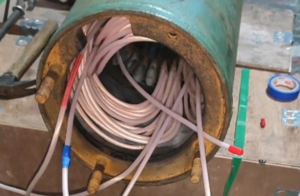
Preparation and disassembly begins with marking the joints between front and rear end caps and the base to ensure correct reassembly and prevent rotor inflexibility caused by assembly errors. During winding removal, the iron core must be protected—silicon steel sheets should not be warped, shifted, or burred at slot edges. The recommended method is to cut the coil from one end with diagonal pliers, then pull it out from the other end with pliers .
Coil winding and insertion requires a properly sized winding mold to ensure that coil ends have adequate clearance and that coils fit correctly into the slots. The “three-plane method” is used for embedding wires: one phase is embedded completely before the next, creating a three-layer end configuration. Critical precautions include positioning the first two “hanging handle” coils correctly to prevent scratching the stator core during insertion of subsequent coils, minimizing the use of scribing boards to avoid insulation damage, ensuring interphase insulation paper is properly positioned to strictly separate two-phase coils, and for water-filled motors, avoiding excessive compaction of coils in slots so that water can flow freely to dissipate heat for the winding .
Joint insulation requires careful preparation. The sheath and insulation layer are stripped at the joint, and the paint layer and oxide layer on the copper wire surface are removed. Conductors are twisted and soldered, then sharp corners, burrs, and residual solder are removed. The joint is wrapped with two layers of polyethylene tape in half-wrap fashion, followed by six layers of butyl self-adhesive tape stretched to approximately twice its length (creating a tight, seamless joint), and finally two layers of polyethylene or polyester adhesive tape for mechanical protection .
Reassembly requires cleanliness and precision. The limit screw at the bottom is carefully adjusted to allow the rotor to rotate freely, and the locking nut is tightened. The end cover is installed in its original sealing position, taking care not to damage the rubber sealing ring in the inner hole of the sealing box. When assembling an integral sealing box, only gentle pushing is required—it should not be knocked .
Technical Standards
The manufacture of PE2+PA submersible winding wire is governed by recognized standards. The Indian Standard IS 8783 (Part 4/Sec 2) specifically covers cross-linked polyethylene insulated and polyamide jacketed wires for submersible motors . This standard supersedes the earlier 1995 version and remains current. The general requirements for conductor data are specified in IS 8783 (Part 1), materials for dielectric and jacket in Part 2, and methods of tests in Part 3 . For mechanical property verification, IEC 60811-1-1 specifies procedures for tensile strength and elongation testing. Dielectric breakdown strength testing follows DIN VDE 0303-21, and insulation resistance measurement follows IEC 60093

Reviews
There are no reviews yet.