
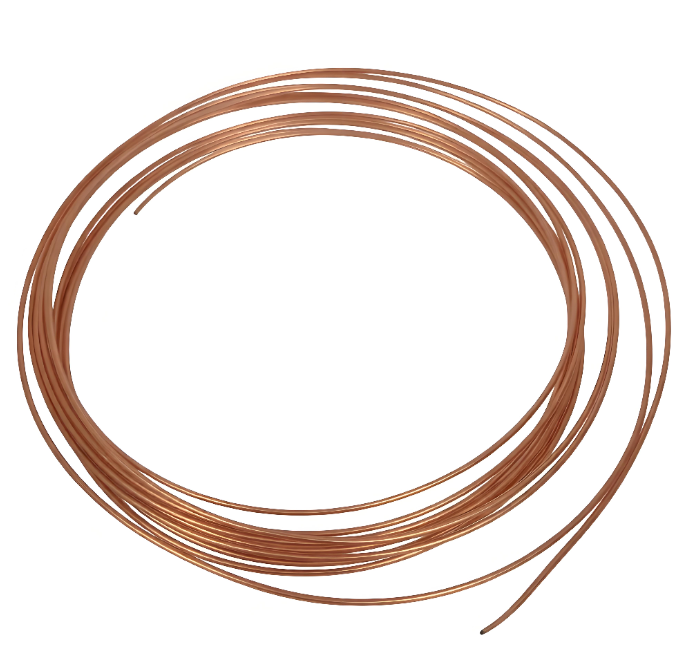
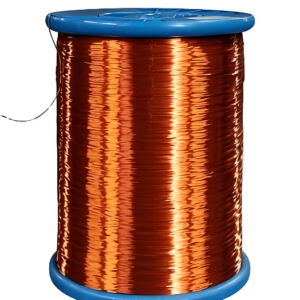
View more products about submersible pump winding wire+
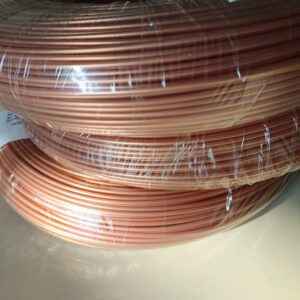
The PE2-PA winding wire achieves its performance advantages through the cross-linking of the polyethylene molecular structure. This process transforms the polymer from a thermoplastic material into a thermoset, significantly increasing its resistance to deformation and degradation at elevated temperatures . The polyamide sheath, typically applied with a wall thickness between 0.1 mm and 0.3 mm, provides surface protection that allows the wire to withstand the mechanical stresses of winding operations without damage to the primary insulation .
The electrical properties of PE2-PA wire are exceptional. The dielectric breakdown strength reaches 70 kV/mm when tested at 50 Hz and 20°C according to DIN VDE 0303-21 . The specific insulation resistance measures 10¹⁰ Ω·cm at 20°C per IEC 60093, ensuring minimal leakage current in water-filled environments . Mechanical testing according to IEC 60811-1-1 verifies a minimum tensile strength of 10 N/mm² and elongation at break of 100% at 23°C, with these values maintained even after aging at 80°C for seven days .
Submersible Motor Applications
Submersible motors wound with PE2-PA wire exhibit several distinctive operational characteristics that differentiate them from conventional motors. These motors are designed for continuous operation in water, with the stator winding in direct contact with the surrounding fluid. The PE2 insulation is specifically formulated to resist water penetration and prevent the formation of water trees that would degrade dielectric strength over time.
The 50°C operating temperature rating is significant for practical applications. Franklin Electric, a major submersible motor manufacturer, recently extended approval of their PPC insulated winding wire for operation at ambient conditions up to 50°C, noting that the wire “demonstrated superior insulation properties and suitability” after extensive laboratory and field testing . This temperature rating accommodates the thermal conditions encountered in deep well installations, where the surrounding water provides cooling but the motor may experience localized heating during high-load operation.
PE2-PA wound motors offer superior resistance to voltage fluctuations compared to standard motor windings . This characteristic is particularly valuable in agricultural and remote industrial settings where grid stability cannot be guaranteed. The cross-linked insulation maintains its dielectric integrity under transient overvoltage conditions that would cause premature failure in motors with less robust insulation systems.
Winding Process Design
The design of the winding process for PE2-PA submersible motors requires careful attention to wire tension control, a factor that directly determines both winding quality and insulation integrity. Research published in IEEE Xplore on automatic stator winding machines emphasizes that improper wire tension leads to insulation damage, reduced fill factor, and compromised motor reliability . When tension is not properly controlled, the wire may be stretched during winding, increasing its resistance and potentially causing insulation damage .
For submersible motors using PE2-PA wire, the polyamide outer sheath provides a critical protective function during the winding operation. The smooth surface of the PA sheath allows the wire to slide more easily through winding equipment and into stator slots, reducing the risk of insulation damage from abrasion against slot edges and adjacent wire turns. This is particularly important for smaller conductor diameters where the insulation wall is thinner and more vulnerable to mechanical stress.
Modern winding practice for submersible motors increasingly favors active tension control systems using servomotors rather than passive devices such as dancer arms or hysteresis brakes. Research on servo-controlled wire tensioning systems notes that passive devices cannot respond quickly enough at higher winding speeds, resulting in sudden tension changes that cause the wire to tremble or stretch . Active control systems using load cell feedback provide the precise tension regulation necessary to achieve high slot fill factors without damaging the PE2-PA insulation .
The winding process itself has evolved significantly for submersible motor applications. Patent literature on submersible motor manufacturing describes the transition from traditional “sew-through” winding methods to form-wound coil techniques . In the conventional sew-through process, round conductors are threaded back and forth through closed stator slots multiple times, a lengthy process that introduces repeated handling damage to the wire . The form-wound approach uses pre-formed conductors that are inserted into the slots and then bent and joined to complete the coils. This method reduces the risk of insulation damage because the wire is bent only once during coil formation rather than being repeatedly threaded through slots .
For PE2-PA wire in submersible motors, the form-wound process offers additional advantages. The pre-formed conductors can be precisely positioned, allowing better control over the insulation system and ensuring that the polyamide sheath remains intact throughout the winding operation. The reduced handling also minimizes the risk of creating pinholes or scratches in the insulation that could become initiation points for water treeing during service.
Quality Verification
Finished PE2-PA winding wire undergoes comprehensive testing to verify compliance with specification requirements. Dimensional inspection confirms conductor diameter, insulation thickness, and overall wire diameter against the tolerances specified in the applicable product standard. Dielectric breakdown testing verifies the insulation strength at the specified test voltage. Water resistance testing is particularly critical for submersible applications, with finished wire samples immersed in water at elevated temperature to confirm that insulation resistance and breakdown voltage remain within acceptable limits after exposure.

Reviews
There are no reviews yet.