
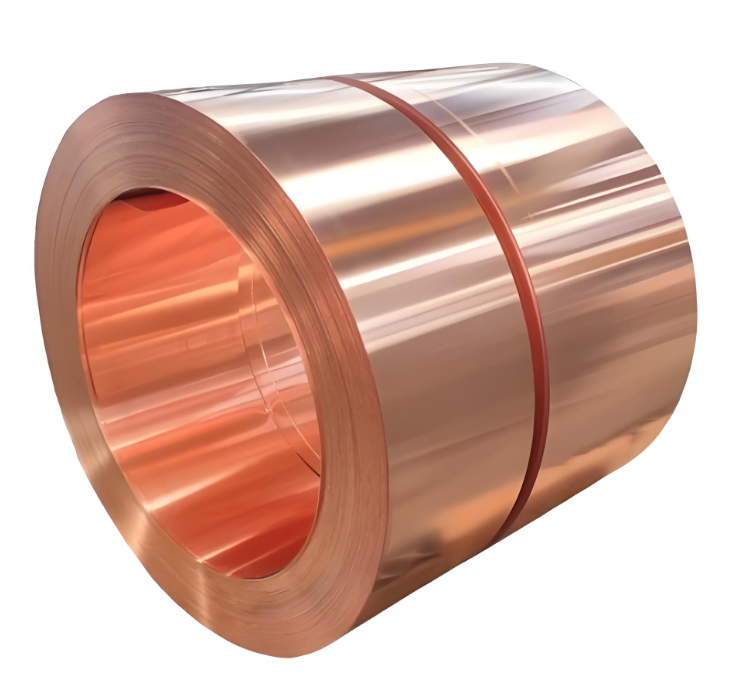
View more products about copper strip+
Fundamental Material Properties
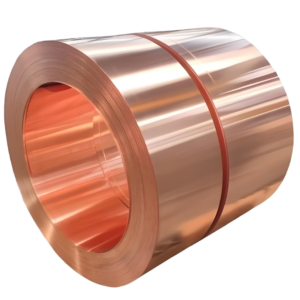
Copper foil used in transformer windings is manufactured from high-purity copper, typically containing a minimum of 99.90% copper . The material exhibits benchmark electrical performance with an electrical resistivity of 1.69 µΩ·cm at 20°C, establishing it as the reference standard against which all other conductor materials are measured . Its thermal conductivity of 401 W/m·K is likewise exceptional, enabling efficient heat dissipation from winding hotspots .
The material is commonly supplied in annealed (soft) or half-hard tempers. Annealed copper foil offers elongation of 20-50%, providing excellent ductility for winding operations and resistance to work hardening during forming . This combination of properties makes copper foil particularly well-suited to applications where minimizing resistive losses and maximizing heat dissipation are critical design requirements .
Dimensional Specifications
Transformer copper foil is available in a wide range of dimensions to accommodate diverse winding configurations. Thickness typically ranges from 0.035mm to 0.300mm for standard applications , with some specialised configurations using foils up to 0.5mm or thicker for high-current windings. Width availability varies by supplier, with standard offerings spanning 6mm to 50mm in common ranges , and wider foils available for larger transformer applications.
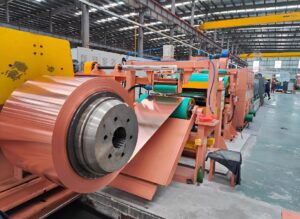
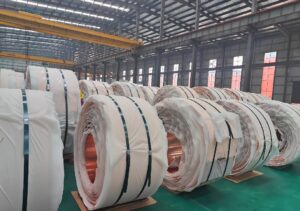
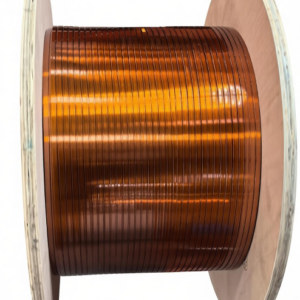
The continuous spooled format of copper foil supports roll-to-roll processing and high-volume automated winding operations . This format is particularly advantageous for inductive component and transformer production, where consistent foil properties across the full roll length directly affect product performance and manufacturing yield .
Applications in Transformer Windings
Low-Voltage Windings
In low-voltage (LV) applications, copper foil winding offers significant advantages over traditional round wire construction. The foil winding configuration provides uniformly distributed turn-to-turn capacitance along the winding, resulting in a small potential gradient and strong impulse voltage withstand capability . This characteristic is particularly valuable in transformers subjected to voltage surges and switching transients.
Foil windings also offer superior mechanical short-circuit strength due to the inherent electromagnetic balance achieved through continuous foil construction . The absence of helical angles at winding ends reduces uneven ampere-turn distribution, minimising axial forces produced by leakage fields and improving the transformer’s short-circuit withstand capability . Foil-wound LV transformers in the 1 kVA to 500 kVA range typically achieve efficiencies exceeding 96% with temperature rises maintained at ≤70°C .
Electromagnetic and Electrostatic Shielding
Copper foil with insulating overlays is commonly employed as electromagnetic or electrostatic shielding between primary and secondary windings . Flexible copper foil laminated with insulating materials such as PET film or aramid paper provides effective shielding while maintaining excellent soldering behaviour . This application is critical in transformers requiring minimised capacitive coupling between windings or reduced electromagnetic interference.
High-Frequency Transformers
The application of copper foil in high-frequency transformers presents both opportunities and challenges. At elevated frequencies, skin effect and proximity effect become significant factors influencing AC resistance . Skin effect causes current to migrate toward the conductor surface, effectively reducing the usable cross-sectional area and increasing resistance. Proximity effect, caused by interaction with nearby magnetic fields, further disrupts current flow and contributes to AC losses .
Copper foil offers advantages in high-frequency designs through optimisation of the height-to-width ratio. Recent research has demonstrated that selecting appropriate foil dimensions can mitigate eddy-current losses and improve performance . However, comparative studies between copper foil and Litz wire transformers at frequencies of 10 kHz and above have shown that Litz wire offers superior AC resistance factors due to its multi-strand construction, which effectively divides current flow and reduces skin effect losses .
Performance Advantages
Size Reduction and Thermal Management
Copper foil windings optimise space utilisation compared to traditional magnet wire, enabling more compact transformer designs . The flat, wide geometry of foil conductors provides improved surface area for heat dissipation, allowing more effective thermal management . This is particularly important in high-power-density applications where temperature rise must be carefully controlled.
Reduced Voltage Stress and Robustness
Foil construction facilitates a reduction in voltage stresses between turns in the winding, contributing to improved insulation reliability and longer service life . Foil-wound components also offer increased mechanical strength compared to wire-wound counterparts, making them more resistant to vibration and thermal cycling damage .
Cost Effectiveness
While copper remains more expensive than aluminium, copper foil offers significant cost advantages over Litz wire for many applications . The simpler manufacturing process and broader availability make copper foil a cost-effective solution for transformers where high-frequency losses are manageable.
Comparison with Alternative Conductors
Copper Foil vs. Aluminium Foil
Aluminium foil offers lower material cost and reduced weight—approximately one-third the density of copper—but requires larger cross-sectional areas to achieve equivalent current-carrying capacity due to lower conductivity (≈61% IACS). The choice between copper and aluminium foil depends on specific application requirements: cost sensitivity, space constraints, weight limits, and efficiency targets. Copper remains preferred for applications where minimum size and maximum efficiency are paramount.
Copper Foil vs. Litz Wire
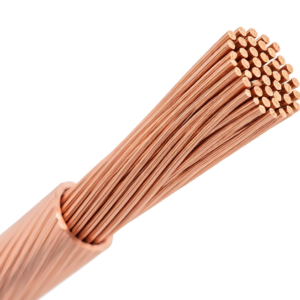
Litz wire reduces AC losses by dividing current flow between multiple insulated strands braided together in a pattern that minimises skin and proximity effects . This makes Litz wire particularly advantageous at frequencies above 10 kHz, where skin depth becomes small . Copper foil, by contrast, offers improved thermal dissipation, simpler manufacturing, and substantially lower cost . The choice depends on operating frequency, efficiency requirements, and budget constraints.

Reviews
There are no reviews yet.