
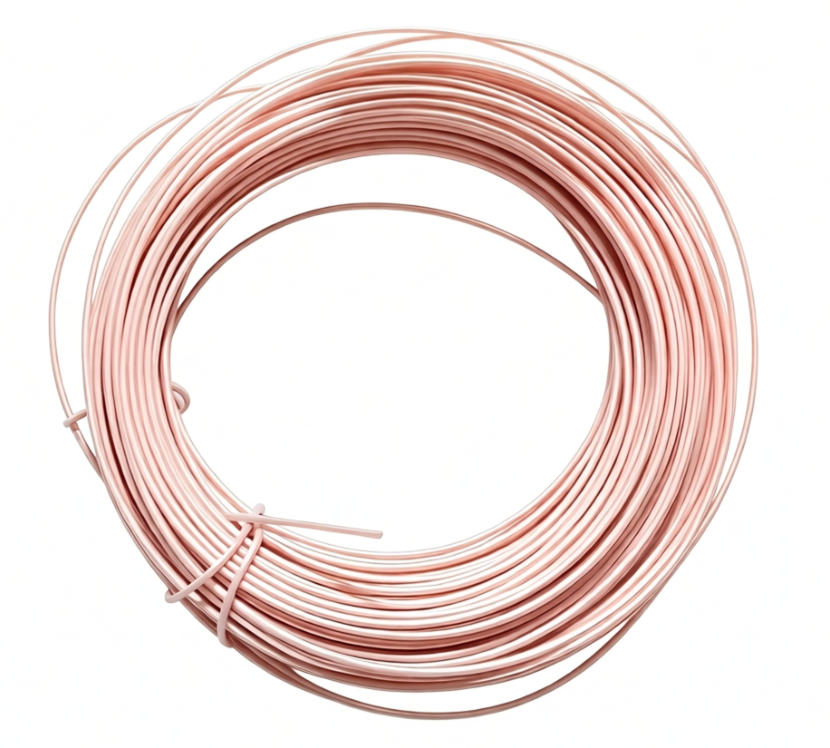
View more products about submersible pump winding wire+
Historical Origins and Early Development
The story of PE2-PA winding wire begins not with the material itself but with the submersible motor. Wet-stator motors, in which the winding operates in direct contact with the surrounding fluid, created an insulation challenge that conventional enameled magnet wire could not solve. Early submersible motors relied on PVC insulation, but PVC has a fundamental limitation: it softens and degrades when conductor temperatures exceed approximately 60°C. As borehole depths increased and motor power ratings grew, heat generation within the winding became the limiting factor for motor life.
The German cable manufacturer Norddeutsche Seekabelwerke (NSW) played a foundational role in solving this problem. NSW had been producing underwater cables since 1899 and began manufacturing plastic-insulated winding wires specifically for submersible motors in 1946. Drawing on their experience with submarine cable insulation, NSW engineers recognized that cross-linked polyethylene offered dielectric properties superior to PVC while maintaining flexibility. The cross-linking process, whether achieved chemically or through electron beam radiation, transforms polyethylene from a thermoplastic that softens with heat into a thermoset material that retains its integrity at temperatures well above PVC’s limits.
The addition of the polyamide outer sheath came as a practical refinement. Cross-linked polyethylene, while electrically excellent, has a relatively soft surface that abrades easily during winding insertion. A thin nylon layer over the PE2 provided the mechanical toughness needed to survive contact with stator laminations and slot edges without compromising the dielectric performance of the underlying insulation. By the 1970s and 1980s, the PE2-PA construction had become the standard for high-quality submersible motor windings in Europe, with NSW and other specialized manufacturers supplying motor builders across the continent.
Expansion to Global Markets and the Emergence of Chinese Production
Through the 1990s and 2000s, PE2-PA winding wire transitioned from a niche European product to a global standard. Major submersible motor manufacturers, including Franklin Electric, Grundfos, DAB, Ebara, and Vansan, adopted PE2-PA insulation for their rewindable motor lines. The wire’s ability to operate continuously in water at temperatures up to 50°C without derating—compared to PVC’s 30°C limit—made it indispensable for motors installed in deep wells and industrial applications where water temperatures rise significantly during operation.
Chinese manufacturers entered the PE2-PA winding wire market as part of the broader expansion of China’s electrical equipment industry. Companies such as Shaying Submersible Wire Factory in Hebei Province began producing cross-linked polyethylene insulated and nylon jacketed winding wires, initially for domestic motor manufacturers and later for export markets. The Chinese product range now spans conductor diameters from 0.3 mm to 6.0 mm, with both solid and stranded constructions, meeting the dimensional and performance requirements established by international standards such as IEC 60811 and DIN VDE.
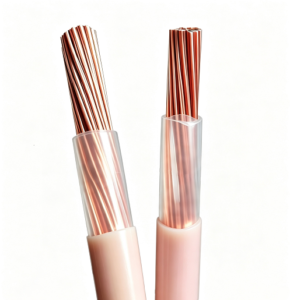
The Chinese PE2-PA wire industry has benefited from the maturation of cross-linking technology, which is now well understood and widely licensed. While exact manufacturing processes remain proprietary, the fundamental approach—extruding polyethylene over a copper conductor, cross-linking the polymer through radiation or chemical means, and applying a polyamide sheath by a second extrusion pass—is followed by producers worldwide. Chinese manufacturers have demonstrated the capability to produce wire meeting the key technical benchmarks: dielectric breakdown strength of approximately 70 kV/mm, specific insulation resistance of 10^16 Ω·cm, and tensile strength exceeding 10 N/mm². These values match those published by European producers such as Vansan, indicating that the performance gap between Chinese and European PE2-PA wire has narrowed substantially.
Realistic Performance After Rewinding with PE2-PA Wire
When a submersible motor is rewound with PE2-PA wire, the achievable performance depends on several factors: the quality of the wire itself, the skill of the rewinding technician, the condition of the stator core and other components, and the operating conditions to which the motor is returned. Under favorable circumstances, a properly rewound motor can meet or even exceed its original design specifications.
Thermal Performance
The most immediate and measurable benefit of PE2-PA insulation is its thermal rating. Motors wound with standard PVC insulation are typically limited to liquid temperatures of 30°C without derating. A PE2-PA rewind raises this threshold to 50°C for continuous operation, meaning the motor can handle substantially warmer water without the winding temperatures exceeding the insulation’s capabilities. In practice, this thermal margin translates directly into extended motor life. Insulation aging follows a well-established principle that life is halved for every 8°C to 15°C increase in continuous operating temperature. By providing a larger thermal buffer between normal operating temperatures and the insulation’s maximum rating, PE2-PA wire reduces the rate of insulation degradation and delays the onset of failure.
Electrical Performance and Reliability
The dielectric properties of PE2-PA insulation support reliable operation at the voltage levels typical of submersible motors, from standard 380–415 V three-phase supply through to higher-voltage motors in the kilovolt range. The cross-linked polyethylene layer provides high dielectric strength and stable insulation resistance under continuous immersion, while the polyamide sheath protects the critical dielectric layer from mechanical damage during operation and any subsequent handling. For motors controlled by variable frequency drives, the PE2-PA insulation system offers superior resistance to the voltage spikes and harmonic stresses imposed by pulse-width modulation waveforms.
Mechanical and Operational Durability
The polyamide sheath contributes significantly to the practical durability of the rewound motor. Its low friction surface facilitates winding insertion, reducing the risk of insulation damage during the rewind process itself. Once in service, the sheath resists abrasion from vibration and the slight movement of conductors that occurs under electromagnetic forces. The result is a winding that can withstand the mechanical rigors of submersible operation—including the thermal cycling that causes expansion and contraction of copper and insulation—without developing the insulation faults that lead to premature failure.
Comparative Performance Context
It is important to recognize that a rewind, however well executed, cannot exceed the fundamental design limits of the motor. A PE2-PA rewind restores the motor to its intended performance level and provides the thermal and electrical margins inherent in the insulation system, but it does not increase the motor’s power rating or improve the hydraulic performance of the pump end. The benefits are in reliability, longevity, and the ability to operate in conditions that would overwhelm a motor with inferior insulation. For motors that failed because their original PVC windings could not tolerate the actual operating temperatures encountered in service, a PE2-PA rewind addresses the root cause of failure and can be expected to deliver significantly longer service life under the same conditions.

Reviews
There are no reviews yet.