
View more products about submersible pump winding wire+
Conductor Construction and Material
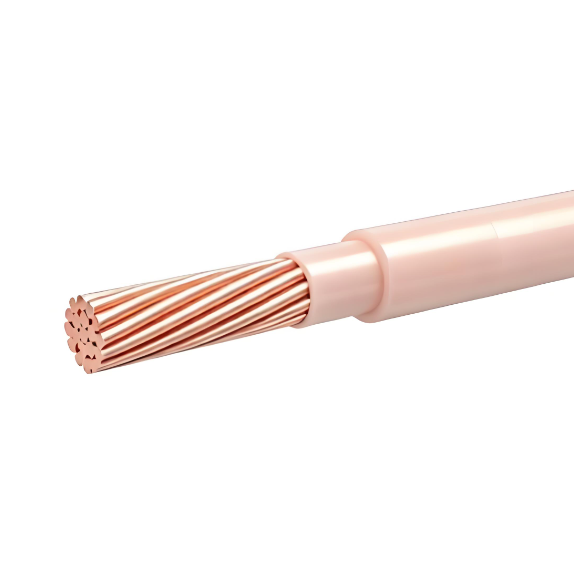
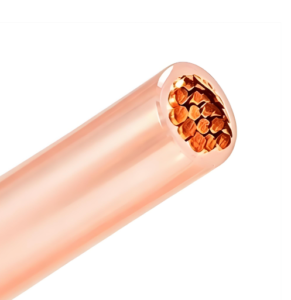
The copper conductor is manufactured from oxygen-free copper rod with a copper content of 99.97% or higher . Oxygen-free copper is specified because the absence of oxygen prevents embrittlement at elevated temperatures and ensures consistent electrical conductivity throughout the conductor‘s service life. The 19-strand configuration provides the flexibility necessary for winding into motor stator slots while maintaining the current-carrying capacity required for medium-power applications. The stranded design also offers redundancy; minor damage to individual strands during handling does not compromise the conductor’s overall electrical integrity.
Insulation System: PE2 and PA Layers
The dual-layer insulation system consists of an inner cross-linked polyethylene (PE2) layer and an outer polyamide (PA) sheath. The PE2 insulation provides the primary dielectric barrier. Cross-linking transforms the polyethylene from a thermoplastic to a thermoset material, significantly improving its thermal stability and resistance to deformation under electrical and thermal stress. The cross-linking process is the key mechanism that achieves increased heat resistance, enabling reliable operation at temperatures up to 50°C in water-filled submersible motors .
The PA sheath, typically applied in thicknesses ranging from 0.1 mm to 0.3 mm, serves a distinctly mechanical function. It protects the PE2 insulation from abrasion during winding and operation, provides a smooth surface finish that facilitates efficient winding, and adds a secondary barrier against water ingress . The polyamide material also contributes to the wire‘s resistance to environmental cracking and chemical attack.
Technical specifications for the PE2/PA insulation system include dielectric breakdown strength of 70 kV/mm at 50 Hz and 20°C according to DIN VDE 0303-21, specific insulation resistance of 10¹⁰ Ω·cm at 20°C per IEC 60093, and minimum tensile strength of 10 N/mm² with elongation at break of 100% at 23°C per IEC 60811-1-1. After aging at 80°C for seven days, these mechanical properties remain stable, demonstrating the long-term reliability of the insulation system .
International Pump Brands Using PE2/PA Winding Wire
Several major international submersible pump manufacturers have adopted PE2/PA winding wire as a standard or optional insulation for their motor products.
Franklin Electric has approved its PPC insulated winding wire for variable frequency drive operation and ambient conditions up to 50°C following extensive laboratory and field testing. The company continues to install radiation-crosslinked PE2/PA winding as standard in all synchronous and 12-inch rewindable motors .
Vansan, the Turkish pump manufacturer, is the only submersible motor manufacturer worldwide that produces PE2/PA winding wire in its own factory. The company‘s full stainless steel 3S motors are wound with PE2+PA insulated wires as standard, providing what Vansan describes as “superior performance compared to the other types of submersible motors” with “high resistance against voltage fluctuation” and “longer life” .
EBAFA Pumps Europe specifies PE2+PA winding wires as standard in its BSM 3S submersible motors. The company‘s technical documentation highlights “high quality PE2+PA winding wires” as a general feature and lists the benefits including longer life, high resistance against voltage fluctuation, and greater safety factor than standard motors .
Panelli Pumps offers PE2+PA winding as an option for its 12-inch submersible motors, enabling operation at water temperatures up to 50°C compared to the standard 30°C rating with PE or PVC insulation .
DAB Pumps specifies PE2+PA windings for its TR 12 rewindable 12-inch submersible motors, noting that this insulation allows use in special applications and with inverters .
Grundfos specifies PE/PA insulated stator windings for its SP series deep well pumps, with suitability for continuous operation and temperatures up to 50°C .
Suitable Pump Applications
The PE2/PA 19/0.68 winding wire is designed for water-filled submersible motors operating under demanding conditions. The 19-strand construction with 6.9 mm² cross-section is particularly suited for:
Deep well pumps for municipal and agricultural water supply, where motors operate continuously for years with minimal maintenance access. The wire‘s water resistance and mechanical durability ensure reliable operation in wells with water pH between 6.5 and 8.5 and water pressure below 1 MPa .
Irrigation systems requiring motors that can withstand voltage fluctuations and operate at water temperatures up to 50°C. The PE2/PA construction provides a greater safety factor than standard motor windings, making it suitable for agricultural environments where grid stability may vary .
Industrial water management applications including process water handling and cooling systems where continuous duty operation and long service life are essential.
Oil-filled and sewage pump motors, where the PE2/PA insulation provides resistance to oil, acid, alkali, and salt exposure in addition to water resistance .
Motor Rewinding and Repair Process
The rewindable design of submersible motors allows for complete access to the windings when repair or replacement is required. The rewinding process for motors using PE2/PA winding wire involves several critical steps .
Disassembly preparation begins with marking the front and rear end caps and the frame joints to ensure correct reassembly. This marking prevents assembly errors that could cause rotor misalignment. During winding removal, the iron core must be protected from damage—silicon steel sheets should not be warped, shifted, or burred at slot edges. The recommended method is to cut the coil ends with diagonal pliers on one side, then extract the coil from the other side .
Coil winding requires a properly sized winding form to ensure that coil ends maintain adequate clearance and that coils fit correctly into the slots. The “three-plane method” is used for coil insertion: one phase is wound completely before the next, creating a three-layer end configuration. Critical precautions include positioning the first two “hanging” coils correctly to prevent scraping of the stator core during insertion of subsequent coils, minimizing the use of slot liners to avoid insulation damage, ensuring phase insulation paper is properly positioned, and—for oil-filled and water-filled motors—avoiding excessive compaction of coils in slots so that oil or water can flow freely for winding cooling .
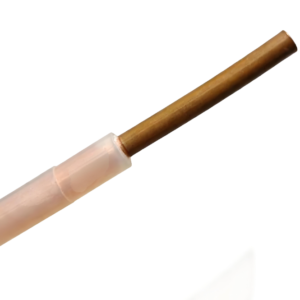
Joint insulation requires careful preparation. The sheath and insulation are stripped from the joint area, and the copper surface is cleaned of enamel and oxidation. The conductors are twisted and soldered, then sharp edges, burrs, and residual flux are removed. The joint is wrapped with two layers of polyethylene tape in half-overlap fashion, followed by six layers of butyl self-adhesive tape stretched to approximately twice its length (ensuring a tight, gap-free seal), and finally two layers of polyethylene or polyester adhesive tape for mechanical protection .
Reassembly requires cleanliness and precision. The bottom limit screw is carefully adjusted so the rotor turns freely, and the lock nut is tightened. The end caps are installed in their original positions, taking care not to damage the rubber sealing rings in the seal box. For integral seal boxes, the component should only be pushed in gently—never struck with a hammer

Reviews
There are no reviews yet.