
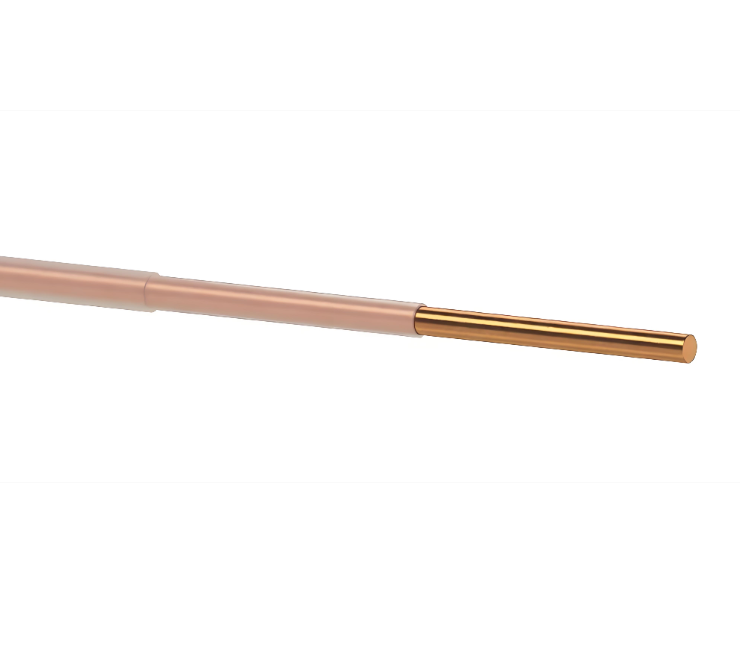
View more products about submersible pump winding wire+
Defining Properties of PE/PA Double-Layer Winding Wire
Thermal and Electrical Performance
The cross-linked structure of the PE2 insulation is the foundation of the wire‘s thermal capability. While standard PE softens and deforms at elevated temperatures, cross-linked PE2 maintains its dielectric integrity up to approximately 90°C conductor temperature. This thermal margin is critical in submersible motors, where heat dissipation is limited by the surrounding fluid and where ambient water temperatures can reach 50°C in deep wells or geothermal applications.
Electrically, PE2 offers a dielectric constant of approximately 2.3 and a breakdown strength that exceeds 70 kV/mm at power frequencies. These properties ensure reliable insulation even under the voltage transients produced by variable frequency drives (VFDs), a growing requirement in modern submersible installations.
Mechanical and Chemical Protection from the PA Sheath
The polyamide outer sheath serves a protective function that is essential in submersible service. During motor winding, the wire is pulled through slot liners, bent around end turns, and compacted into stator slots. Without the PA sheath, the softer PE2 insulation would be vulnerable to abrasion and scoring, creating thin spots that become dielectric weak points. The nylon sheath absorbs this mechanical punishment, preserving the integrity of the underlying insulation.
Chemically, the PA sheath provides resistance to water, oil, acids, alkalis, and salts. This makes PE/PA winding wire suitable for water with pH values from 6.5 to 8.5, covering most natural and industrial water sources. For oil-filled motors, the sheath resists swelling and degradation that would otherwise compromise insulation resistance.
Water and Pressure Resistance
The combination of a low-permeability PE2 layer and a continuous PA sheath creates a highly effective moisture barrier. The wire is rated for water pressure up to 1 MPa, sufficient for the immersion depths encountered in most deep-well and borehole applications. The PA sheath prevents water from reaching the PE2 surface, where even trace moisture could eventually initiate electrical treeing under sustained voltage stress.
Selecting PE/PA Winding Wire for Motor Repair
Rewinding a submersible motor is a precision operation, and wire selection is the single most consequential decision in the process. An incorrectly specified winding wire will fail prematurely, often within months, regardless of the quality of the winding work itself. The following criteria should guide the selection process.
Determine the Required Conductor Cross-Section
The first step is to identify the original conductor size. Submersible winding wire is available with solid conductors from approximately 0.6 mm to 4.6 mm diameter, corresponding to cross-sectional areas from about 0.283 mm² to 16.6 mm². Larger motors and higher-power ratings typically use stranded conductors, such as 19-strand configurations, which offer greater flexibility for difficult winding patterns.
The original nameplate data and the physical dimensions of the stator slots should be used to confirm the correct wire size. Using a conductor that is too small will increase resistance and heating; using one that is too large will make winding difficult and may not fit the slot.
Verify Voltage and Thermal Ratings
The standard PE/PA winding wire is rated for 450/750V (U₀/U), which covers the vast majority of submersible pump motors. For higher-voltage applications, including mine dewatering pumps and large industrial units, the insulation thickness must be increased, and a semiconducting layer may be required between the conductor and the PE2 insulation.
The thermal rating must match the motor’s operating conditions. Standard PE/PA wire is rated to 90°C conductor temperature. If the motor operates in hot water or is driven by a VFD with high switching frequencies, the thermal margin should be evaluated carefully. For applications requiring higher temperatures, alternative insulation systems such as HT4 are available, but PE/PA remains the standard for the majority of submersible motors.
Assess the Operating Environment
The fluid in which the motor operates determines the chemical demands on the insulation. Clean water with pH between 6.5 and 8.5 is well within the capability of standard PE/PA wire. For seawater, mining water, or chemically contaminated fluids, the PA sheath’s resistance to salts and mild chemicals must be verified against the specific fluid composition. The wire is suitable for oil-filled motors as well, provided the oil is compatible with polyamide.
Confirm the Insulation Dimensions
The outer diameter of the insulated wire must be compatible with the stator slot dimensions and the slot liner. PE/PA winding wire is manufactured with PE2 wall thicknesses starting from approximately 0.3 mm and PA sheaths from 0.1 mm to 0.2 mm. For a given conductor size, the overall diameter determines whether the winding will fit the available slot space. Undersized insulation creates dielectric risk; oversized insulation may prevent the required number of turns from fitting.
Source from a Manufacturer with Verified Testing
The performance of PE/PA winding wire depends on precise control of the extrusion and cross-linking processes. Conductor eccentricity, insulation concentricity, sheath continuity, and the degree of cross-linking all affect the final product‘s reliability. Reputable manufacturers test their wire against the applicable standards, including measurements of tensile strength, elongation, dielectric breakdown, and insulation resistance. When selecting wire for a repair, verification of these test results provides assurance that the wire will perform as specified.
Technical Standards Governing PE/PA Winding Wire
International Standards
The International Electrotechnical Commission (IEC) provides the global framework for winding wire testing and specification. IEC 60851-5 establishes the test methods for electrical properties of winding wires, including breakdown voltage and insulation continuity. This standard is directly applicable to the evaluation of PE/PA winding wire’s dielectric performance. It is maintained by IEC Technical Committee TC 55 (Winding Wires), the same committee responsible for the broader IEC 60317 series on winding wire specifications.
IEC 60317-21 specifies requirements for solderable polyurethane enamelled round copper wire overcoated with polyamide, class 155. While this standard addresses a different construction (enamel plus polyamide overcoat rather than extruded PE2 plus PA), it provides relevant test methodologies and quality benchmarks for dual-layer insulation systems. The pin hole test and dielectric dissipation factor requirements in this standard are particularly relevant to insulation integrity.
For broader electrical insulation system evaluations, IEC 60243-1 governs the determination of electric strength of solid insulating materials at power frequencies, providing the methodology for the breakdown strength measurements that characterize PE2 performance.
Chinese Industry Standards
The primary Chinese standard for PE/PA submersible winding wire is JB/T 4014.2-2013 (“Winding wires for submersible motors — Part 2: Polyethylene insulated nylon sheathed water-resistant winding wires with rated voltages no more than 450/750V”). This standard specifies the product varieties, dimensions, technical requirements, and inspection methods. It is the reference standard for the PE+PA construction in the Chinese market and is widely cited in manufacturer documentation.
The related JB/T 4014.1 (General requirements) provides the overarching framework, while JB/T 4014.4 addresses cross-linked polyethylene insulated versions for higher voltage ratings.
Research and Application by Leading Manufacturers
Franklin Electric, a global leader in submersible motor technology, has conducted extensive laboratory and field testing of PE2/PA winding wire. The company‘s research confirmed that radiation-crosslinked PE2/PA winding exhibits “superior insulation properties and suitability” for demanding applications, leading to its approval for variable frequency drive operation and ambient conditions up to 50°C. Franklin Electric continues to install PE2/PA winding as standard in all synchronous and 12-inch rewindable motors.
Norddeutsche Seekabelwerke (NSW) , a German manufacturer with over a century of experience in underwater cable and wire production, has manufactured PE2/PA winding wires since 1946. NSW’s technical documentation confirms the 90°C thermal rating of PE2 insulation and the protective function of the PA sheath, noting that the company‘s products have “proven their durability and reliability over many decades”.
Centel (Turkey) produces PE2+PA double insulation winding wire rated to 120°C for hot water applications, with published sizing tables covering conductor diameters from 0.70 mm to 4.00 mm and corresponding overall diameters

Reviews
There are no reviews yet.