
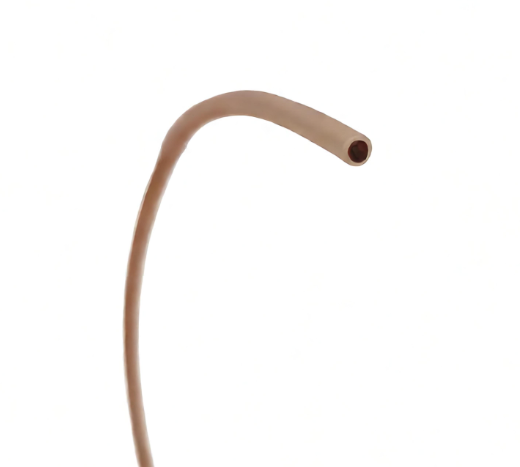
View more products about submersible pump winding wire+
Raw Materials
Copper Conductor
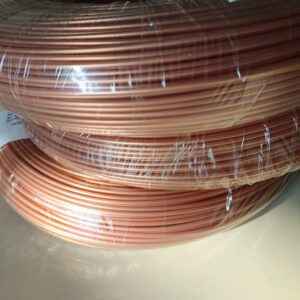
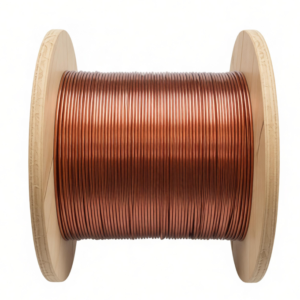
The conductive core of PE2/PA winding wire is manufactured from oxygen-free copper with a purity of at least 99.97%. Single-strand conductors typically range from 0.6 mm to 4.6 mm in diameter, corresponding to cross-sectional areas from approximately 0.283 mm² to 16.6 mm². For larger current-carrying capacities, multi-strand configurations are employed, with 7-strand and 19-strand constructions being common. The copper is selected for high electrical conductivity, low resistance, and sufficient ductility to withstand the mechanical stresses of winding without fracturing.
Polyethylene (PE2) Insulation Compound
The inner insulation layer is formulated from low-density polyethylene (LDPE) or linear low-density polyethylene (LLDPE), which serves as the base polymer. To achieve the PE2 designation—indicating cross-linking—the polyethylene compound is modified during processing rather than in its raw state. The base polyethylene is selected for its:
-
High dielectric breakdown strength
-
Low dielectric constant (approximately 2.3 at 800 Hz)
-
Extremely low water permeability
-
Chemical stability in aqueous environments
Cross-Linking Agents and Additives
The cross-linking transformation of polyethylene from a thermoplastic to a thermoset material requires specific additives. Two principal cross-linking methodologies are employed:
Silane Grafting: An unsaturated silane compound, such as vinyltrimethoxysilane, is graft-polymerized onto the polyethylene backbone using an organic peroxide initiator, typically dicumyl peroxide (DCP). The DCP is added in proportions not exceeding 0.15 parts by mass per 100 parts of polyethylene . A siloxane condensation catalyst is incorporated to facilitate cross-linking upon exposure to moisture.
Radiation Cross-Linking: Alternatively, the polyethylene compound is cross-linked by irradiation with ionizing radiation, typically electron beams at energy levels around 1 MeV . This method requires the incorporation of antioxidants to prevent radiation-induced degradation.
Antioxidants: To protect the PE2 insulation from thermal and radiation-induced deterioration, antioxidants containing aromatic rings are added. Suitable compounds include 2,2-thio-diethylenebis[3-(3,5-di-t-butyl-4-hydroxyphenyl)propionate], pentaerythrityl-tetrakis[3-(3,5-di-t-butyl-4-hydroxyphenyl)propionate], and 4,4′-thiobis(3-methyl-6-t-butylphenol), among others. These antioxidants are typically added at concentrations of not less than 0.1 parts by mass per 100 parts of polyethylene .
Polyamide (PA) Sheath Material
The outer protective layer is formulated from polyamide 11 or polyamide 12 (nylon 11 or nylon 12), which are chosen for their combination of toughness, chemical resistance, and low moisture absorption. These long-chain polyamides offer better dimensional stability under humid conditions compared to shorter-chain nylons such as nylon 6 or nylon 6,6. The PA sheath is typically applied at a wall thickness of 0.1 mm to 0.3 mm, depending on the conductor diameter and voltage rating.
Manufacturing Process
Conductor Preparation and Preheating
The manufacturing process begins with the copper conductor. Bare copper wire is drawn to the specified diameter and cleaned to remove surface contaminants. Before extrusion, the copper conductor is preheated to approximately 55°C . Preheating serves two purposes: it improves adhesion between the copper and the polyethylene insulation, and it reduces thermal shock when the molten polymer contacts the conductor.
Extrusion of PE2 Insulation
The polyethylene compound, compounded with cross-linking agents (in the silane grafting method) or antioxidants (in the radiation method), is fed into an extruder. The compound is melted and extruded onto the preheated copper conductor. Barrel temperatures typically range from 115°C to 140°C, with die head temperatures around 123°C to 125°C, depending on the specific compound formulation . The extrusion process must maintain precise concentricity to avoid thin spots that could lead to electrical failure.
Cross-Linking Step
Following extrusion, the PE2 layer undergoes cross-linking. In the silane grafting method, cross-linking occurs through exposure to moisture. The extruded wire may be passed through a continuous vulcanization (CV) tube containing pressurized nitrogen at approximately 1 MPa, with a heating section at about 200°C and a cross-linking section at 280°C, and a residence time of approximately 5 minutes . The moisture present facilitates the condensation reaction between silane groups, forming siloxane cross-links between polymer chains.
In the radiation cross-linking method, the extruded wire is passed through an electron beam irradiation chamber where it is exposed to ionizing radiation at energy levels sufficient to generate free radicals and form cross-links between polyethylene chains. The radiation dose is carefully controlled to achieve the desired degree of cross-linking without degrading the polymer .
Application of PA Sheath
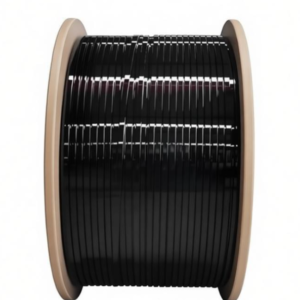
The polyamide sheath is applied over the cross-linked PE2 layer through a second extrusion process. The PA compound is melted and extruded at temperatures appropriate for polyamide processing, typically in the range of 200°C to 250°C. The sheath is applied concentrically and must be continuous, free from pinholes, and well-adhered to the PE2 surface to prevent water ingress at the interface.
Cooling, Testing, and Finishing
After extrusion of the PA sheath, the wire passes through cooling troughs to solidify the polymer. The finished wire is then subjected to online inspection for dimensional accuracy and visual defects. Samples are taken for laboratory testing according to the applicable standards, including measurements of insulation thickness, concentricity, and dielectric properties.
Technical Standards
Chinese Industry Standards
The primary technical standard governing PE2/PA submersible winding wire in China is JB/T 4014.2-2013 (“Submersible motor winding wire — Part 2: Polyethylene insulated nylon sheathed water resistant wire for rated voltages up to and including 450/750V”). This standard specifies the varieties, specifications, technical requirements, and inspection methods for this product category . It is issued by the Ministry of Industry and Information Technology and falls under the jurisdiction of the National Technical Committee for Standardization of Electric Wires and Cables. The standard replaced the 1996 version and took effect on July 1, 2014.
Related standards include JB/T 4014.1 (General requirements) and JB/T 4014.4 (Cross-linked polyethylene insulated versions for voltages up to 600/1000V).
International Standards
At the international level, the IEC 60317 series, developed by IEC Technical Committee TC 55 (Winding Wires), provides the general framework for winding wire specifications. Specifically, IEC 60317-0-1:2013 establishes general requirements for enamelled round copper winding wires, including definitions of nominal conductor dimensions, elongation requirements, breakdown voltage test provisions, and continuity of insulation specifications . While IEC 60317-0-1 addresses enamelled wires rather than extruded polymer-insulated constructions, its test methodologies and quality assurance principles are widely referenced in the PE2/PA context.
IEC 60811-1-1 provides the test methods for measuring tensile strength and elongation of insulation and sheath materials, which are directly applicable to PE2/PA wire evaluation. The Vansan technical documentation references this standard for its PE2/PA winding wire testing, specifying tensile strength ≥ 10 N/mm² and elongation ≥ 100% at 23°C .
IEC 60093 specifies methods for determining volume resistivity and surface resistivity of solid electrical insulating materials. Vansan reports specific insulation resistance of 10¹⁴ Ω·cm at 20°C for its PE2/PA wire, tested in accordance with this standard .
DIN VDE 0303-21 (now harmonized as DIN EN 60243-1 / IEC 60243-1) governs the determination of electric strength of solid insulating materials at power frequencies . Vansan‘s published dielectric breakdown strength of 70 kV/mm at 20°C, 50 Hz for PE2/PA insulation is tested according to this standard .
For broader electrical insulation system evaluations, UL 1446 (Systems of Insulating Materials — General) provides the framework for assessing the thermal compatibility of insulation components, including magnet wire coatings, in complete systems . This standard is relevant when PE2/PA wire is evaluated as part of a motor‘s overall insulation system.
Research and Application by Leading Companies
Franklin Electric has conducted extensive laboratory and field testing of PE2/PA winding wire for submersible motors. The company‘s research confirms that radiation-crosslinked PE2/PA winding exhibits “superior insulation properties and suitability” for demanding applications . Following comprehensive testing, Franklin Electric released PE2/PA winding for operation with variable frequency drives (VFD) and hot water applications up to 50°C ambient. The company continues to install PE2/PA as standard in all synchronous and 12-inch rewindable motors, and motors with special windings remain available in PE2/PA construction .
Vansan (Turkey) is notable as the only submersible motor manufacturer worldwide that produces PE2/PA winding wire in its own factory. Their published technical data confirms the wire‘s performance characteristics, including dielectric breakdown strength of 70 kV/mm, tensile strength of ≥ 10 N/mm², and elongation of ≥ 100% at 23°C, with these mechanical properties maintained after aging at 80°C for 7 days . Vansan positions PE2/PA winding as providing “more safety factor than standard motors” and enabling operation at well water temperatures of 50°C . Their HT (High Temperature) motors, distinguished by red coloring, achieve approximately 20% higher power ratings compared to standard motors due to the thermal capabilities of PE2/PA insulation .
Grundfos (Denmark) specifies PE2/PA winding wire with polyamide sheathing for surface protection in its submersible motor documentation, noting its suitability for conductor temperatures up to 90°C.
Conclusion
PE2/PA insulated copper submersible winding wire represents a carefully engineered materials solution for the extreme demands of submerged motor operation. Its raw materials—oxygen-free copper, silane-grafted or radiation-crosslinked polyethylene with aromatic antioxidants, and long-chain polyamide sheath—are selected for their complementary properties: electrical insulation, moisture resistance, mechanical toughness, and chemical stability. The manufacturing process, from conductor preheating through extrusion, cross-linking, and sheath application, requires precise control at every stage to achieve the required performance characteristics. The technical standards governing the product, including JB/T 4014.2-2013 and the IEC 60317 series, provide the framework for quality assurance and international compatibility. Research and application by Franklin Electric, Vansan, Grundfos, and other leading manufacturers continue to validate PE2/PA as the insulation system of choice for reliable submersible motor performance.

Reviews
There are no reviews yet.