
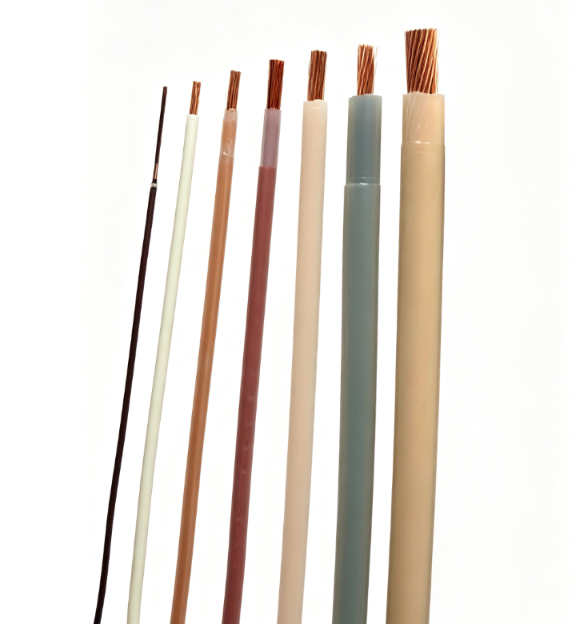
View more products about submersible pump winding wire+
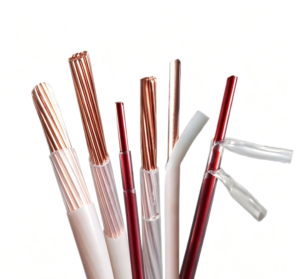
BOPP+PET Winding Wire
BOPP+PET winding wire uses a conductor wrapped with multiple layers of film insulation. The inner layer is typically polyester (PET) film, selected for its excellent electrical and mechanical properties. Over this, bi-axially oriented polypropylene (BOPP) film is applied, often in both opaque white and transparent forms, to build a composite dielectric barrier.
The BOPP component contributes excellent opacity, gloss surface, hot-tack and heat-seal strength, mechanical properties, and barrier properties. The PET film provides the primary dielectric function with good thermal stability. All films are sequentially wrapped over the conductor and passed through an oven to seal them together into a cohesive insulation system.
This construction is favored where a film-based insulation is preferred over extruded polymer sheaths, offering a distinct balance of dielectric strength and mechanical toughness. It suits submersible motors operating at moderate voltages and temperatures where a wrapped-film insulation system is compatible with the motor design.
PE+PA Winding Wire
PE+PA winding wire consists of a solid or stranded copper conductor insulated with polyethylene and overcoated with a polyamide (nylon) sheath. The polyethylene layer provides the primary electrical insulation, while the polyamide outer sheath delivers mechanical protection, abrasion resistance, and a smooth surface finish that facilitates winding.
Polyethylene insulated wires are generally used in submersible motors operating at higher voltages and at temperatures up to a maximum of approximately 70°C, depending on the specific compound and application. The polyamide sheath, typically applied in thicknesses ranging from 0.1 mm to 0.3 mm depending on the PE2 outer diameter, protects the insulation during handling and winding operations.
This construction is widely used in water-filled submersible motors where reliable electrical insulation and mechanical durability are required at moderate operating temperatures.
PE2+PA Winding Wire
PE2+PA represents a significant advancement over standard PE+PA construction. The “PE2” designation indicates cross-linked polyethylene, produced through a process that creates molecular bonds between polymer chains. This cross-linking dramatically improves the thermal stability of the insulation.
PE2-insulated winding wires are generally used in submersible motors operating at higher voltages and at temperatures up to a maximum of 90°C. The increased resistance to heat is achieved by cross-linking the polyethylene. The polyamide (PA) outer sheath continues to provide mechanical protection and surface smoothness.
Typical technical parameters for PE2+PA winding wire include dielectric breakdown strength of 70 kV/mm at 50 Hz (tested at 20°C per DIN VDE 0303-21), specific insulation resistance of 10¹⁰ Ω·cm at 20°C (IEC 60093), tensile strength of at least 10 N/mm² at 23°C, and elongation at break of at least 100% (IEC 60811-1-1). After aging at 80°C for 7 days, tensile strength remains at least 10 N/mm² and elongation at least 100%.
This construction is available in conductor diameters from 0.8 mm to 3.4 mm and is well suited for submersible motors requiring reliable operation at elevated temperatures with high resistance to voltage fluctuations.
XLPE+PA Winding Wire
XLPE+PA winding wire uses cross-linked polyethylene as the primary insulation, overcoated with a polyamide sheath. This construction is specifically engineered for higher voltage applications, including 3 kV, 6 kV, and 10 kV submersible motors used in mining and seawater environments.
For 6 kV and 10 kV ratings, the wire is designed for a working temperature of 90°C, a water pH range of 6.5–8.5, and hydraulic pressure of 3 MPa. The insulation thickness average should not be less than 90% of the nominal value, with eccentricity in the same cross-section not exceeding 10%. The insulation layer must be tightly attached to the conductor with a smooth surface free from bubbles, impurities, and mechanical damage.
The protective sheath must conform to JB/T4014.2 standards, using nylon 1010 or high-strength, high-voltage-resistant polyolefin. The thinnest point of the sheath should not be less than 0.05 mm below the nominal value. Mechanical properties of the XLPE insulation layer include tensile strength of at least 15 N/mm² before aging (with maximum ±25% variation after 28 days at 90°C) and elongation at break of at least 200%.
This construction is manufactured in accordance with JB/T4014 for cross-linked insulation with PA sheathing, GB/T3048 for electrical properties testing, GB/3953 for round copper wires, and GB/T6108 for winding wire conductors.
HL+XLPE+PA Winding Wire
HL+XLPE+PA represents the most advanced construction in our submersible winding wire range, designed for high-voltage applications where electrical stress management is critical.
The “HL” designation refers to a semiconducting layer applied between the copper conductor and the XLPE insulation. This layer serves to equalize the electric field at the conductor surface, reducing localized electrical stress concentrations that could lead to premature insulation failure. For voltages of 3 kV and above, such a semiconducting layer is recommended between the copper conductor and the insulating sheath.
The complete construction consists of: copper conductor, semiconducting layer (HL), cross-linked polyethylene (XLPE) insulation, and polyamide (PA) outer sheath. The semiconducting layer is typically applied in a thickness of 0.1 mm to 0.3 mm, depending on the conductor diameter and voltage rating.
This construction is specifically designed for high-voltage submersible motors, including those operating at 3 kV, 6 kV, and 10 kV, where reliable dielectric performance under water is essential.
Manufacturing Standards and Quality Assurance
All submersible winding wires we produce are manufactured in accordance with recognized technical standards. The primary standard governing submersible motor winding wire construction is JB/T4014, which covers cross-linked insulation with PA sheathing. Electrical properties are tested per GB/T3048, while conductor requirements follow GB/3953 for round copper wires and GB/T6108 for winding wire conductors.
For international customers, our products are designed to align with IEC standards where applicable. IEC 60317-0-1 specifies general requirements for enamelled round copper winding wires, including breakdown voltage and continuity of insulation requirements. The NEMA MW 1000 standard provides reference requirements for round film-insulated magnet wire. We can supply products tested to these or other specified standards upon request.
Customization and Global Distribution
At Zhengzhou Tasuu Winding Wire Industry Co., Ltd., we understand that submersible motor designs vary widely. For this reason, we offer comprehensive customization of our winding wires to meet your specific requirements. Customizable parameters include conductor diameter, insulation thickness, sheath thickness, and performance characteristics such as breakdown voltage and thermal rating.
Our global distribution model includes cooperating local warehouses in strategic regions. Customers can place orders with us directly, and we arrange transportation to the local warehouse. You then collect your goods from the warehouse at your convenience. This approach reduces delivery time, simplifies logistics, and provides a local point of contact for order fulfillment.
Whether you require BOPP+PET film-wrapped wire for a specific motor design, PE2+PA for standard submersible applications, XLPE+PA for higher voltage motors, or HL+XLPE+PA for the most demanding high-voltage installations, Zhengzhou Tasuu has the manufacturing capability and technical expertise to deliver. Contact us with your specifications, and we will provide a customized solution that meets your submersible motor winding needs.

Reviews
There are no reviews yet.