
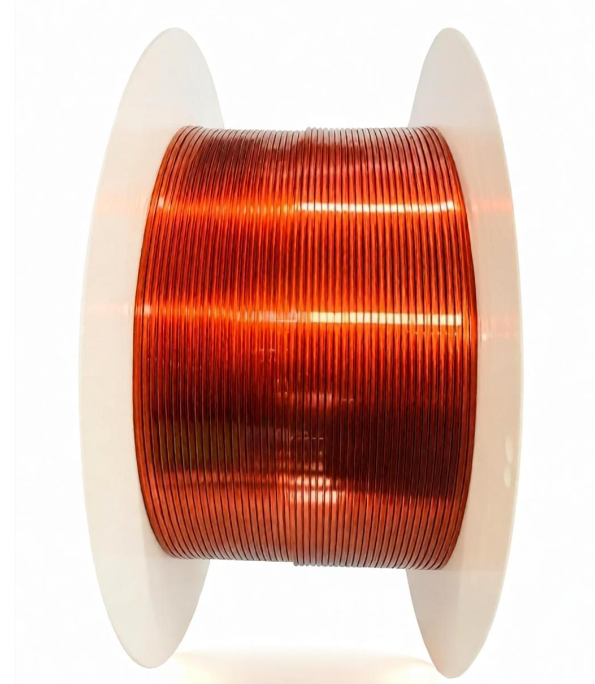
View more products about flat enameled cca wire+
Performance Characteristics
Conductivity and Resistance: The electrical performance differential between the two grades is modest but measurable. The DC resistivity of 30% copper ECCA is approximately 1.59 times that of pure copper, while 40% copper ECCA is approximately 1.55 times. In practical transformer winding, this means that for the same resistance requirement, a slightly larger conductor cross-section is needed compared to pure copper, but the 40% grade provides marginally better efficiency.
Weight and Cost: The 40% copper wire weighs approximately 9% more than the 30% grade, reflecting the higher copper content. Both grades offer significant weight savings over pure copper wire, which has a density of 8.89 g/cm³. The cost difference between the two grades directly reflects the copper price premium, as copper is substantially more expensive than aluminum. The selection depends on whether the designer prioritizes lower electrical losses (favoring 40%) or lower weight and material cost (favoring 30%).
Solderability: Both grades benefit from the copper cladding, which provides the same solderability as pure copper wire without the need for special pretreatment . This is a significant advantage over pure aluminum wire, which requires specialized soldering techniques. For polyurethane enamel variants, the insulation is directly solderable, eliminating the need for mechanical or chemical stripping .
Transformer Applications
Flat ECCA wire is specifically engineered for transformer windings where the rectangular cross-section maximizes space factor—allowing more conductor material within the same winding window compared to round wire . Common transformer applications for Class 155 flat ECCA wire include :
-
Dry-type and Oil-immersed Transformers
-
High-frequency Transformers – the copper cladding provides excellent high-frequency transmission characteristics
-
General Transformers and Inductors – cost-effective alternative to pure copper
-
Distribution Transformers – weight reduction without compromising thermal reliability
-
Welding Transformers
Selection Guidance: The choice between 30% and 40% copper content depends on the transformer design criteria:
-
30% Copper is preferred where minimizing weight and material cost is paramount, and slightly higher resistance can be accommodated through larger conductor cross-sections.
-
40% Copper is preferred where maximizing conductivity and minimizing I²R losses is critical, and the additional weight and cost are acceptable trade-offs.

Reviews
There are no reviews yet.