
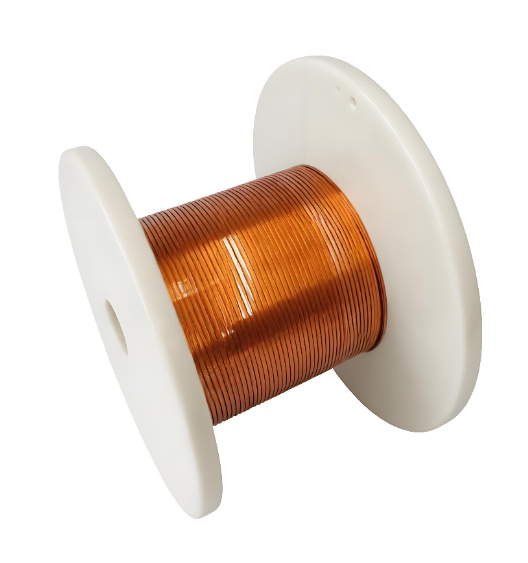
View more products about flat enameled copper wire+
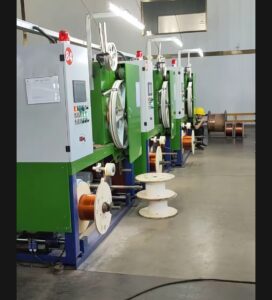
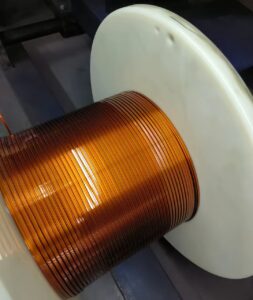
Dimensional Capabilities and Customization
Chinese manufacturers excel at producing rectangular wires in a wide spectrum of dimensions to meet diverse application requirements. The conductor thickness (the “a” side) can range from a minimum of 0.8 mm up to a maximum of 10.0 mm, while the conductor width (the “b” side) spans from 1.0 mm to 22.0 mm. Typical tolerances are exceptionally tight, with thickness held to within ±0.005 to ±0.030 mm and width to within ±0.010 to ±0.050 mm.
The aspect ratio, defined as the width divided by the thickness, can be customized from a minimum of 1:1 to a maximum of 30:1, allowing for highly specific geometric profiles. The insulation build is available in single, heavy, or custom builds, each with thickness tolerances maintained at ±0.005 mm. Furthermore, the corner radius (R-angle) is fully customizable to suit specific winding and coil-forming requirements. For ultra-compact applications, super-thin configurations are also available, with some manufacturers producing rectangular wires as thin as 0.035mm × 0.3mm. The ability to achieve such precise dimensional control ensures optimal space utilization in winding designs, as detailed in product specifications for super-thin rectangular enameled copper wire.
Technical Performance Specifications
High-temperature rectangular copper winding wire offers superior electrical and mechanical properties essential for demanding applications. The base conductor is manufactured from electrolytic tough pitch copper, achieving a minimum conductivity of 100% IACS, which ensures minimal resistive losses. For a typical super-thin product, such as a 0.1mm × 1.5mm rectangular wire, the conductor resistance at 20°C is approximately 120 to 124 Ω/km, with elongation exceeding 42%. This high elongation ensures excellent windability and reliability during the coil winding process.
The insulation system provides a robust dielectric barrier, with a typical minimum breakdown voltage of 0.7 kV, far exceeding the requirements for most low-voltage applications. The cut-through temperature of the insulation system consistently exceeds its rated thermal class, providing an additional safety margin. The copper filling factor, or space factor, reaches up to 96%, which is substantially higher than the 78-80% typical of round wires. This allows more copper in the same winding window, reducing I²R losses and improving thermal management. Detailed electrical and mechanical performance data for specific grades, such as the 0.8mm × 0.35mm AIW 220 wire, are available in manufacturer datasheets.
Manufacturing Standards and Quality Compliance
Chinese manufacturers produce rectangular copper winding wire in strict compliance with a comprehensive suite of international standards to ensure consistent quality, performance, and safety. The primary technical specification is IEC 60317-0-2, which defines the general requirements for enamelled rectangular copper winding wires. For the 220°C thermal class, specific requirements are outlined in IEC 60317-28, covering polyamide-imide enamelled rectangular wires. Additional compliance includes NEMA MW 1000, the North American standard for magnet wire, and JIS C3003, the Japanese Industrial Standard.
On the domestic front, manufacturers adhere to GB/T 6109, the Chinese national standard for enamelled winding wires. Environmental compliance with RoHS is standard, and many manufacturers offer UL safety certification for their products, providing additional assurance for global applications.
Application Advantages
The unique geometry and thermal properties of high-temperature rectangular wire confer several distinct engineering advantages. The superior space factor enables the production of smaller, lighter, and thinner end products without compromising electrical or thermal performance. The larger surface area-to-volume ratio of rectangular conductors enables more efficient heat transfer, reducing the risk of thermal degradation in high-load applications. In high-frequency applications, the optimized geometry of flat conductors helps mitigate skin effect and proximity effect losses, improving overall system efficiency, particularly in high-frequency transformers and inductors.
Cost Competitiveness of Chinese Manufacturers
Chinese manufacturers offer compelling value propositions that extend beyond technical performance. Factory-direct pricing eliminates intermediaries, with typical pricing structures based on a transparent formula of “copper price plus processing fee plus freight.” This allows for predictable and competitive costing. Furthermore, many suppliers offer low Minimum Order Quantities (MOQs), sometimes as low as 10kg, which accommodates both prototyping and small-batch production requirements.
The flexibility to support custom dimensions, insulation builds, and aspect ratios up to 25:1 or higher is a hallmark of the industry. Combined with fast delivery, with average lead times of 7 to 15 working days, Chinese manufacturers provide a responsive and cost-effective supply chain.
Quality Assurance and Certification
Established Chinese manufacturers implement comprehensive quality control systems, including continuous in-process monitoring, dimensional inspection using precision gauging, and rigorous electrical, mechanical, and thermal testing. Key tests include breakdown voltage, resistance, flexibility, adhesion, elongation, heat shock, and cut-through temperature. Suppliers often hold certifications including ISO9001 for quality management, RoHS, CE, and UL, with some maintaining Class A supplier status verified by demanding international customers.

Reviews
There are no reviews yet.