
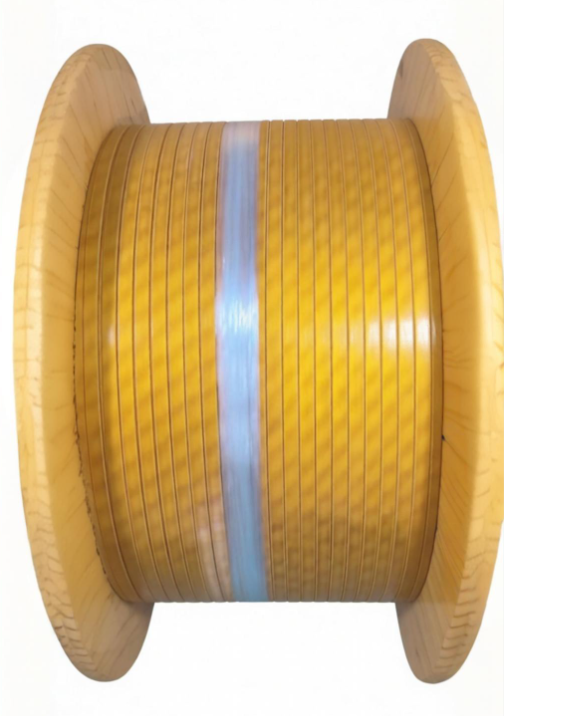
View more products about fiberglass covered winding wires+
Polyimide Film Inner Layer
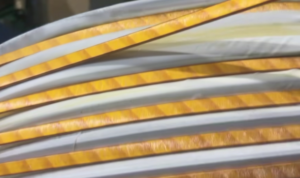
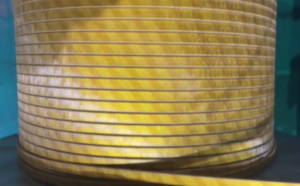
The polyimide film serves as the primary dielectric barrier in this insulation system. Polyimide is renowned in the electrical industry for its exceptional thermal stability, with temperature ratings reaching 220°C for polyimide enamelled wires under IEC 60317-30 specifications . When applied as a film wrap, polyimide provides outstanding dielectric strength, chemical resistance, and the ability to maintain its properties under continuous high-temperature operation.
In the glass-fiber covered polyimide film construction, the polyimide film is typically applied in one or two layers using a half-lap wrapping technique. Standard film thicknesses range from 0.015mm to 0.035mm per layer . This film layer delivers high breakdown voltage while allowing for thinner overall insulation builds compared to alternative insulation systems.
Glass Fiber Outer Covering
Over the polyimide film layer, single or double layers of glass fiber are applied as mechanical reinforcement and additional electrical insulation. The glass fiber layers are typically wound in opposite directions for double-layer constructions, ensuring complete coverage and enhanced mechanical strength . The glass fibers are then impregnated with insulating varnish of the required temperature resistance index, which bonds the glass fibers together and to the underlying film and conductor .
The glass fiber covering provides several critical advantages:
-
Mechanical Protection: The glass fiber layer protects the polyimide film from abrasion during winding operations and from mechanical stress during equipment service.
-
Corona Resistance: The composite structure, particularly when treated with corona-resistant varnishes, enhances resistance to partial discharge .
-
Thermal Stability: The glass fiber reinforcement maintains structural integrity even at elevated temperatures.
Impregnating Varnish
The impregnating varnish is essential for creating a unified insulation system. The varnish penetrates the glass fiber layer, fills voids, and bonds the entire insulation structure to the conductor. The varnish selection determines the final thermal class of the product, with standard options available for thermal classes 155°C, 180°C, and 200°C . For applications requiring enhanced corona resistance, modified varnishes incorporating nano-powders can be specified .
The insulation thickness of glass-fiber covered polyimide film wrapped flat winding wire ranges from 0.20mm to 0.90mm, with a tolerance of ±15%, delivering minimum breakdown voltages from 2,500V for the thinnest configurations up to 6,000V for the thickest. The polyimide film provides the primary dielectric strength, with a single 0.025mm layer typically delivering approximately 3,500V, and the breakdown voltage scales with total insulation thickness when properly impregnated with varnish to eliminate voids. For applications requiring specific breakdown voltage values beyond standard offerings, custom insulation configurations with additional film layers or specialized varnishes are available upon request.
Dimensional Specifications
Conductor Dimensions
Glass-fiber covered polyimide film wrapped flat winding wire is available in a comprehensive range of conductor dimensions to accommodate various application requirements.
For rectangular conductors, the narrow side (a) ranges from 0.30mm to 5.60mm, while the wide side (b) ranges from 2.00mm to 16.00mm . Standard specifications extend the range with narrow side from 0.90mm to 5.60mm and wide side from 3.15mm to 16.00mm . The dimensional tolerances are maintained in accordance with GB/T 7672-2008 or IEC standards.
For round conductors, diameters typically range from Φ1.7mm to Φ6.0mm
Manufacturing Process
Conductor Preparation
The manufacturing process begins with the preparation of the copper or aluminium conductor. For rectangular conductors, the material is drawn and formed to achieve the required dimensions, followed by annealing to achieve the desired flexibility and electrical conductivity. The conductor undergoes cleaning to remove surface contaminants that could affect insulation adhesion.
Polyimide Film Application
The polyimide film is applied to the conductor using a precise wrapping process. The film is typically wrapped in one or two layers using a half-lap technique, ensuring complete coverage with controlled overlap. The wrapping tension is carefully controlled to achieve consistent coverage and avoid gaps that could compromise dielectric integrity.
Glass Fiber Winding
Following the polyimide film application, single or double layers of glass fiber are wound over the film. For double-layer constructions, the two layers are wound in opposite directions to ensure complete coverage and enhanced mechanical strength . The glass fiber winding is performed on specialized machinery with precise tension control.
Impregnation and Curing
The glass fiber-covered wire is then passed through an impregnation station where insulating varnish is applied. The varnish penetrates the glass fiber layer, filling voids and coating the glass fibers. The wire then passes through a curing oven where the varnish is baked, bonding the glass fibers, film, and conductor into a unified insulation system

Reviews
There are no reviews yet.