
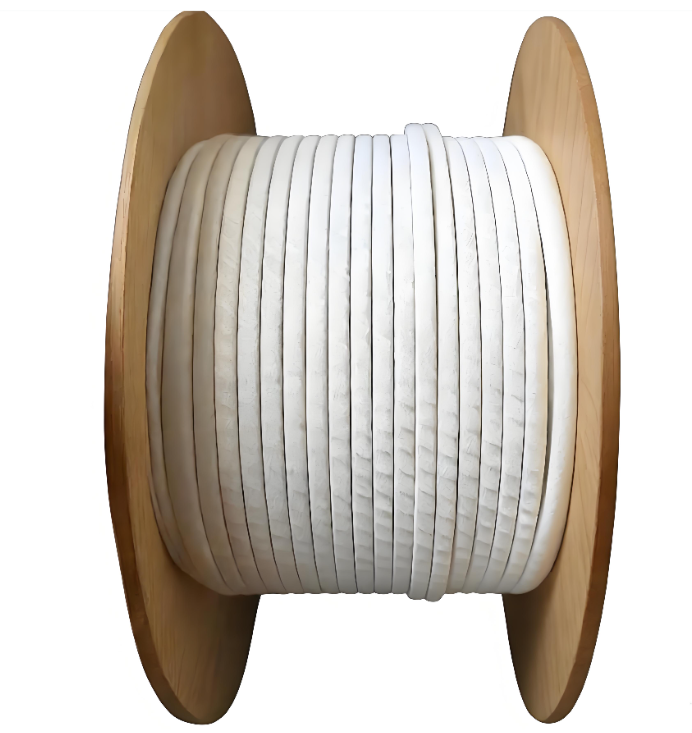
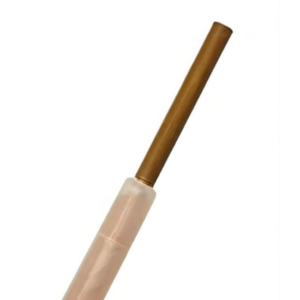
Non-woven paper and mica glass insulated flat winding wire
View more products about fiberglass covered winding wires+
Material Composition and Insulation Structure
Non-Woven Paper Base Layer
The non-woven paper serves as the foundation of this insulation system. Unlike traditional woven fabrics, non-woven materials offer several distinct advantages for winding wire applications. The absence of a woven structure allows for precise cutting without edge fraying or unraveling, resulting in cleaner, more consistent insulation application. The random fiber orientation provides isotropic mechanical properties and uniform porosity, which facilitates thorough impregnation with insulating resins or transformer oil.
Non-woven materials also demonstrate excellent conformability to conductor surfaces, ensuring intimate contact between the insulation and the copper or aluminium conductor. This conformability is particularly valuable for flat conductors, where maintaining consistent insulation coverage around corners and edges is essential for dielectric integrity. The low-density structure of non-woven paper, as described in relevant patent literature, promotes high oil impregnation when used in oil-filled transformers, contributing to reduced dielectric constant and more favorable electric field distribution.
Mica Insulation Layer
Mica forms the dielectric core of this insulation system. Mica is universally recognized in the electrical industry for its exceptional resistance to partial discharges and its ability to maintain dielectric integrity under high-voltage stress. The high energy electrons generated during partial discharges are effectively de-energized by the strong electrostatic fields created by the potassium ion arrays within the mica’s silicate lattice structure. This electronic deactivation mechanism is widely believed to be responsible for mica’s remarkable voltage endurance in high-voltage insulation systems.
The mica is typically applied as mica paper, consisting of small mica flakes bonded together with a resinous binder. The mica paper is combined with a supporting backing—often glass fiber cloth or non-woven material—to provide mechanical reinforcement and facilitate handling during the wrapping process. Industry data indicates that mica tape products for electromagnetic wire wrapping can achieve breakdown voltages exceeding 70 to 80 MV/m, with thermal classes up to 180°C (Class H).
Glass Fiber Reinforcement
Glass fiber reinforcement provides the mechanical backbone of the insulation system. Glass-backed mica paper is widely used in high-voltage motor and generator applications, with patent literature describing glass-backed mica paper pre-treated with resin to the B-stage for interturn insulation. The glass fiber backing serves multiple critical functions: it provides tensile strength during the taping operation, ensures dimensional stability during thermal cycling, and contributes to the overall mechanical robustness of the insulation.
The combination of glass fiber with mica is particularly important for flat conductors, where the insulation must withstand the mechanical stresses of coil forming and insertion into stator slots. The glass backing also facilitates resin penetration during the vacuum pressure impregnation (VPI) process, ensuring thorough filling of the insulation structure with impregnant.
Technical Specifications and Performance
Thermal Performance
Non-woven paper and mica glass insulated flat winding wire is available in multiple thermal classes depending on the resin system employed. Class F (155°C) insulation uses polyester-based resins, while Class H (180°C) capability is achieved with silicone or modified polyesterimide resin systems. In some configurations, thermal ratings up to 200°C are achievable with advanced resin formulations.
The presence of mica in the insulation system provides the temperature resistance, while the non-woven and glass fiber components contribute to mechanical integrity at elevated temperatures. Patent literature on mica paper manufacturing describes insulating materials for Class F (155°C) applications, confirming this thermal class as a common benchmark for mica-based insulation systems.
Electrical Performance
The breakdown voltage of non-woven paper and mica glass insulated wire is determined by the insulation thickness and configuration. For mica tape products used in electromagnetic wire wrapping, breakdown voltage values typically exceed 70 to 80 MV/m, with some products achieving levels above 80 MV/m. This translates to high voltage withstand capability, making the wire suitable for applications operating at voltages up to 35 kV with appropriate insulation build.
The mica component provides superior resistance to partial discharge and corona, which is critical for inverter-fed motors and high-voltage equipment where steep voltage fronts create severe electrical stress. The glass fiber backing contributes to the insulation’s puncture resistance and mechanical endurance under electrical stress.
Mechanical Properties
The composite structure offers excellent mechanical strength and flexibility. The non-woven paper base provides conformability, while the glass fiber backing supplies tensile strength. The combination ensures that the wire can withstand the rigors of coil winding and insertion without insulation damage. For applications requiring particularly high mechanical durability, the mica layer can be combined with additional protective outer layers of glass fiber or other robust materials.
Application Scenarios
High-Voltage Motors and Generators
Non-woven paper and mica glass insulated flat winding wire is extensively used in high-voltage motors and generators, particularly for stator windings. In these applications, the insulation system must withstand both the continuous working voltage stress and the transient overvoltages imposed during service. The mica component provides the necessary dielectric strength, while the glass fiber backing ensures mechanical robustness during coil fabrication and insertion.
Patent literature describes the application of glass-backed mica paper for interturn insulation in high-voltage rotating machines, with the insulation applied to straight slot-engaging parts of the windings before mounting on the stator. This application method ensures that the insulation is mechanically consolidated and thermally cured before the coil is installed, verifying turn insulation integrity at an early manufacturing stage.
Traction Motors for Rail Transport
Railway traction motors represent one of the most demanding applications for this type of winding wire. These motors must operate in confined spaces under continuous vibration, thermal cycling, and mechanical shock while delivering high power output. The non-woven paper and mica glass insulation combination provides the thermal stability up to 180°C, the mechanical durability to withstand vibration, and the dielectric strength required for high-voltage operation.
Transformers
In transformer applications, non-woven paper and mica glass insulated flat winding wire offers distinct advantages. The combination of mica’s dielectric strength with the oil-impregnation characteristics of non-woven paper allows for improved electric field distribution and reduced dielectric constant in the insulation system. This is particularly valuable for oil-immersed transformers, where reducing the dielectric constant of solid insulation can minimize electric field intensity at small gaps and wedge-shaped regions, thereby enhancing transformer reliability and enabling more compact designs.
Both dry-type and oil-immersed transformers benefit from the thermal capability and dielectric reliability of this insulation system.
Inverter-Fed Motors
Modern variable frequency drives subject motor windings to high-voltage spikes and rapid voltage transients. The corona-resistant properties of mica make non-woven paper and mica glass insulated wire suitable for inverter-fed motor applications, where standard insulation systems can suffer premature failure from partial discharge.

Reviews
There are no reviews yet.