
View more products about paper covered winding wires+
Conductor Specifications and Common Dimensions
Conductor Material and Alloys
The aluminium conductor used in kraft paper covered winding wire is manufactured from high-purity electrical grade aluminium, typically alloy grades 1350 or 1370, with an aluminium content exceeding 99.7% . This high purity level is essential for maintaining the required electrical conductivity and minimising resistive losses in transformer windings. The electrical resistivity of the aluminium conductor is specified at no more than 0.0280 Ω·mm²/m at 20°C, ensuring consistent electrical performance across production batches.
Dimensional Ranges for Rectangular Conductors
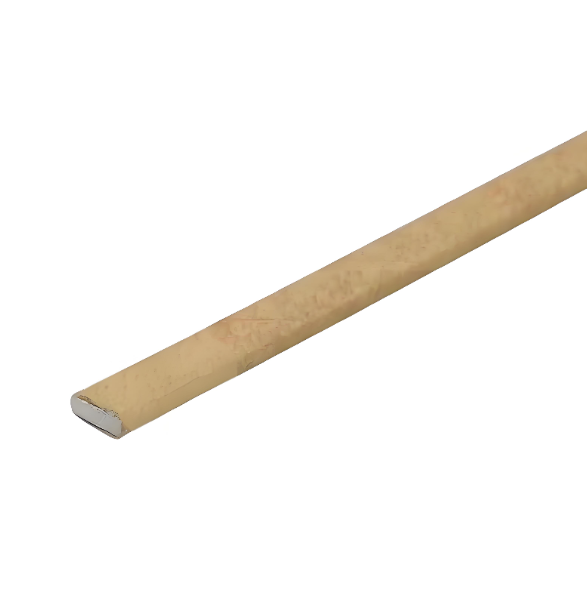
For oil-immersed transformer applications, rectangular conductors are predominantly used due to their superior space factor compared to round wires. The international standard IEC 60317-27-4 specifies the nominal conductor dimensions as follows: width ranging from a minimum of 2.00 mm to a maximum of 16.0 mm, with thickness ranging from a minimum of 0.80 mm to a maximum of 5.60 mm . These dimensional parameters are established by industry standards to ensure compatibility with transformer designs and manufacturing equipment.
In practice, manufacturers commonly supply kraft paper covered aluminium wire in thicknesses from 0.90 mm to 5.60 mm and widths from 3.15 mm to 16.00 mm . The breadth of this dimensional range allows transformer designers to optimise winding configurations for specific voltage and current ratings while maintaining appropriate current density and thermal management.
Dimensional Tolerances
Precision in conductor dimensions is critical for maintaining consistent electrical and thermal performance. Manufacturers typically maintain dimensional tolerances of ±0.010 mm for conductor dimensions, achieved through precise drawing and extrusion processes . This level of accuracy is essential for ensuring uniform paper covering thickness and consistent winding geometry throughout the transformer coil manufacturing process.
The Manufacturing Process
Conductor Preparation
The manufacturing journey begins with high-quality electrical aluminium rods, typically 9.5 mm in diameter, which undergo a series of forming operations to achieve the required rectangular cross-section. The process involves extrusion and drawing through precisely dimensioned dies, followed by annealing to achieve the desired mechanical properties and electrical conductivity . Throughout this forming stage, rigorous in-process quality control ensures dimensional accuracy to within 0.001 mm, representing a critical quality parameter for subsequent winding operations.
Surface Preparation and Cleaning
Following the mechanical forming operations, the aluminium conductor undergoes thorough cleaning using ultrasonic washing systems with pure water . This cleaning step is essential for removing surface contaminants, oxides, and processing residues that could compromise the adhesion of the paper insulation or introduce impurities into the transformer oil during service. Clean conductor surfaces also help maintain consistent electrical contact and prevent localised heating points that could accelerate insulation degradation.
Paper Winding Process
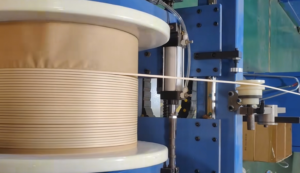
The application of kraft paper insulation represents the defining operation in manufacturing this specialised wire. The paper covering is applied in a spiral wrapping process, where the paper tape is wound around the aluminium conductor with precise tension control and overlap . The number of paper layers applied directly influences the dielectric strength and mechanical robustness of the finished product, with standard configurations ranging from two to four layers or more, depending on the voltage rating and specific application requirements .
The winding process demands careful control of several parameters, including winding tension, paper overlap, and tape feed rate. These factors collectively determine the uniformity and density of the paper covering, which directly affects the dielectric properties and the ability of the wire to maintain consistent insulation thickness throughout the length of the winding. The spiral wrapping technique, while seemingly simple, requires sophisticated machinery capable of maintaining consistent paper placement at production speeds while accommodating various conductor dimensions.
Insulation Materials
Kraft paper remains the most widely used insulation material for this application due to its excellent dielectric properties, compatibility with transformer oil, and cost-effectiveness. The paper used must conform to the specifications outlined in IEC 60554-1 and IEC 60554-3-5, which define the required electrical, mechanical, and physical properties for electrical insulating papers .
Beyond standard kraft paper, manufacturers may offer alternative paper types to meet specific performance requirements. These options include cable paper, telephone paper, high-voltage paper, NOMEX paper, and other specialised insulating papers that offer enhanced thermal stability or dielectric strength . The selection of paper type depends on the transformer’s operating temperature class, voltage rating, and specific customer specifications.
Insulation Configurations
Number of Insulation Layers
The number of kraft paper layers applied to the aluminium conductor represents one of the most critical design parameters, directly influencing the wire’s dielectric withstand capability. Industry practice typically specifies two, three, or four layers of paper covering, with the exact number determined by the transformer’s voltage rating and dielectric requirements . The minimum requirement for oil-immersed transformer applications is two layers of paper tape, which provides the necessary basic insulation for low to medium voltage windings .
Higher voltage applications demand additional insulation layers to withstand increased electrical stress. In such cases, manufacturers may apply three or four layers of paper, providing enhanced dielectric strength and increased safety margins for reliable long-term operation under demanding service conditions. The ability to customise the number of insulation layers represents a significant advantage, allowing transformer manufacturers to specify exactly the insulation level required for their particular design.
Insulation Thickness Specifications
The thickness of the paper covering is specified through standardised insulation thickness values, with accompanying tolerances to ensure consistency. For flat conductors, standard insulation thicknesses include 0.45 mm, 0.60 mm, 0.95 mm, 1.35 mm, 1.60 mm, 1.95 mm, 2.45 mm, and 2.95 mm . Each standard thickness comes with defined maximum and minimum allowable dimensions, ensuring that the finished wire meets the required dielectric and dimensional specifications while accommodating normal manufacturing variations.
For example, a specified insulation thickness of 0.45 mm permits a maximum of 0.57 mm and a minimum of 0.40 mm, providing a controlled range that ensures consistent performance while allowing for the inevitable minor variations in paper thickness and winding tension encountered during production . This standardised approach to insulation thickness enables transformer designers to accurately predict the dielectric strength and overall dimensions of wound coils.
Alternative insulation thicknesses of 0.30 mm, 0.40 mm, and 0.50 mm are also available for applications where reduced insulation thickness is acceptable or where specific design constraints require thinner paper coverings . The availability of multiple standard thickness options provides design flexibility while maintaining the quality assurance benefits of standardised specifications.

Reviews
There are no reviews yet.